Summarize this blog post with:
You probably spend all day thinking about your customers and your growth strategy, but when it comes to your own LinkedIn presence? Crickets.
You know content matters. You know you should be posting. But between product development, fundraising, team management, and actually running the business, your own thought leadership falls to the bottom of the list. I get it.
I talked to Diandra Escobar, a content strategist who works with founders to build their content presence, during my Podcast session, and walked away with a clear, actionable perspective on content creation.


Content is not a Slot Machine
Most founders I know (myself included) approach content the same way: you get a random idea, write a post, hit publish, and hope something happens. Maybe it gets traction, maybe it doesn't. Either way, you are back to square one next week.
Every post is a one-off. You might write something brilliant that even gets great engagement, but you can't replicate it. You don't know why it worked. And when the next post flops, you get discouraged and stop posting for three weeks.
The difference between people who post consistently and people who don't isn't discipline or motivation. It is having a repeatable system.
Content Market Fit
Diandra introduced me to this concept she calls "content market fit." If you're a product person (like me), you know about product-market fit - that magical moment when what you've built actually solves a real problem for real people.
Content market fit is the same idea. It's the iterative process of discovering what resonates with your specific audience through experimentation and data.
As Diandra put it: "Think about content like a scientist thinks about experiments. You have a hypothesis, you test it, you get results, and then you iterate."
This completely shifted my mindset. I stopped thinking "I need to write the perfect post" and started thinking "I need to run experiments and learn."
Here's how content market fit actually works in practice:
Getting to Content Market Fit
You have to write, measure, learn, and adjust. Listen to the feedback that comes from doing it repeatedly and adjust your content.
Here's the practical approach I'm now following:
1. Pick a content type mix based on your current goals (I'll explain the framework below)
2. Choose a format to test (text, carousel, video, etc. - pick one and commit to it for at least 10 posts)
3. Create a hypothesis ("My audience will engage with tactical frameworks about product development")
4. Post and measure the results (not just likes - track saves, shares, DMs, actual conversations)
5. Iterate based on what you learn (double down on what works, adjust what doesn't)
You will be wrong at first. That's expected, but diagnose what happened, improve next time and go through the steps again.
The Content Mix
To run these experiments, you need to know what types of content exist. That's where Diandra's content funnel comes in.
The framework breaks content into four types, each serving a specific purpose. Content mix is simply the breakdown of what types of posts you publish. Instead of randomly posting whatever comes to mind, you intentionally plan what percentage of your content serves each purpose. What I love about this is that it's adaptive based on where you are in your journey.
For example, if you post 10 times per month, a standard content mix should look like this:
- 3 posts of growth content (30%)
- 3 posts of authority content (30%)
- 2-3 posts of conversion content (20-30%)
- 1-2 posts of personal content (10-20%)
The framework breaks content into four types, each serving a specific purpose:
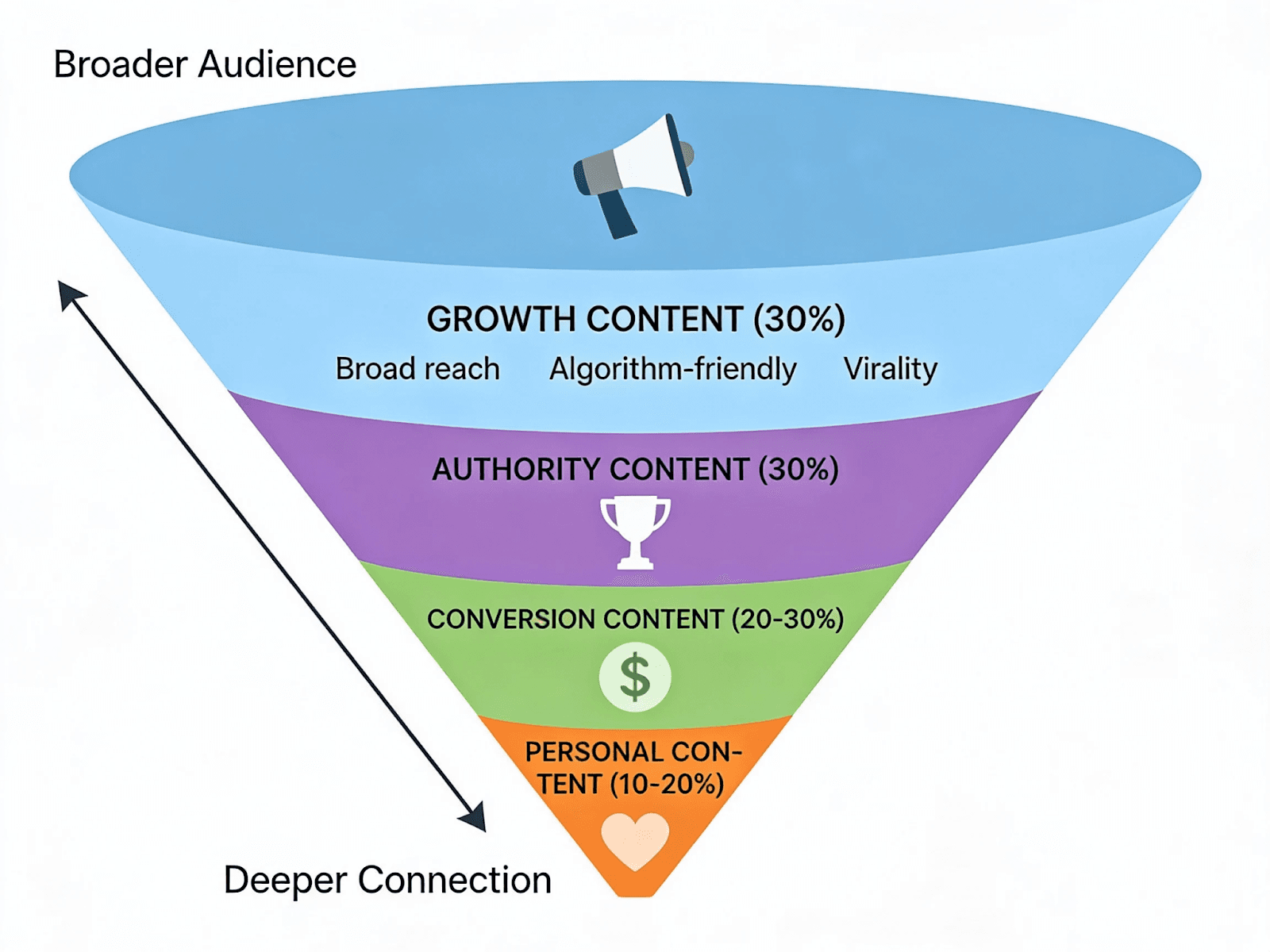
Growth Content (30%)
- Broader audience reach
- Algorithm-friendly formats
- Higher virality potential
- Purpose: Bring new eyeballs to your world
For founders, this looks like industry trends, relatable struggles, and contrarian opinions about your space.
Authority Content (30%)
- Frameworks and step-by-step guides
- Specific tactics that have driven results
- Behind-the-scenes of how you built something
- Purpose: Prove you know what you're doing
This is where you demonstrate deep expertise. Proprietary processes, strategic frameworks, and how you solve customer problems. This content might not go viral, but it builds trust.
Conversion Content (20-30%)
- Direct asks for the sale
- Specific case studies with results
- Clear calls-to-action
- Purpose: Turn attention into revenue
Most founders skip this entirely. You can't be subtle here. Share results from your product, talk about specific outcomes, and actually ask for signups.
Personal Content (10-20%)
- Behind the scenes of your business
- Challenges you've overcome
- Celebrations and milestones
- Purpose: Build human connection
The messy reality of scaling, the mistakes you made with customers, and your philosophy on leadership. People buy from people they trust.
The Key is that these percentages shift
Just starting out? Bump growth content to 50%. You need “reach”.
Building credibility? Double down on authority content - maybe 40-50%.
Have an audience but need revenue? Increase conversion content to 35-40%. Stop being shy about asking.
Once you have figured out your content mix and found your content market fix, you can start scaling content.
Scale Content with Systems
The founders who post consistently aren't more disciplined than you. They have systems.
I used to think consistency was about willpower. "I just need to care more about content." But that's not how it works.
Motivation is unreliable. Some days you're energized. Other days, you're dealing with product issues, customer emergencies, or just feeling burned out. If your content strategy relies on motivation, it will fail.
What works? Systems that remove the need for motivation.
Here's the practical system Diandra recommends:
Step 1: Build Your Content Library
Start a Notion page (or any tool you prefer) and treat it like an idea capture system. Whenever you have a thought, jot it down. These don't need to be perfect; they just need to be there.
Tag each idea: Growth, Authority, Conversion, or Personal.
Step 2: Batch Your Creation
Instead of writing one post every day (which kills momentum), block out 2-3 hours and write 4-5 posts in one focused session. Go back to the Content library that is just ideas, improve them, shape them into full posts. Pull ideas from your content library, knock out multiple posts, and you're set for the week or month.
Step 3: Repurpose Ruthlessly
One good idea shouldn't be used just once. That's inefficient.
Take a framework you wrote about and turn it into:
- A text post for LinkedIn
- A carousel breaking down each step
- A video explaining it
- A section in your newsletter
- A thread on Twitter
Step 4: Know Your Mix
Go back to your content funnel percentages. Write them down. Put them in your content library.
When you batch create, you know exactly what you need: 3 growth posts, 3 authority posts, 2 conversion posts, 1 personal post. Done.
No more "what should I write today?" You've removed the decision fatigue.
The shift for me was realizing: consistency isn't a personality trait. It's a system. Think about how you run your company. You don't rely on motivation to ship products or serve customers - you have processes, templates, workflows. Your content should work the same way.
In my conversation with Diandra, there were many additional tips to improve the content game that I have summarised below.
Quick Tips and Insights
Before you dive in, here are three insights that will save you time:
1. Use Your Beginner's Advantage
If you're just starting with content, you actually have an unfair advantage. When you're a beginner at something, your confidence is higher than when you know more. You don't know enough yet to be paralyzed by all the things you don't know.
How many brilliant founders do you know who never post because they think "everyone already knows this"? Meanwhile, someone who just learned a concept last month posts about it enthusiastically and gets massive engagement.
If you're early in your content journey, this is your window. Use that confidence. Post about what you're learning right now. That window closes as you gain expertise, so capitalize on it while you can.
2. Don't Chase Viral Posts
Viral content is often surface-level content. It's designed to be easy to consume, easy to comment on, and easy to share. But it's also easy to forget.
Think about those "10 tips to grow your startup" posts. They get tons of engagement because anyone can drop a "Great tip!" comment. But do they build trust? Do they demonstrate deep expertise? Do they make someone think "I need to hire this person" or "I should use this product"?
The posts that actually drive revenue are different. They're specific. They show deep expertise. They might only get 50 likes instead of 500 - but those 50 people are your actual target audience.
Would you rather have 1,000 random likes from people who will never become customers, or 50 engaged responses from potential users, investors, or partners who fit your ideal profile?
3. Your Voice Already Exists
You don't need to invent a voice. You need to extract and share what's already there.
Your voice is already hidden in:
- The problems you solve for customers every day
- The frameworks you've developed for your team
- The mistakes you've made and lessons you've learned
- The opinions you hold that differ from the mainstream
Every day, you're solving complex problems, building frameworks, making strategic decisions, and having opinions about what works in your industry. That intellectual output is the content engine.
The frameworks you use internally? Share them. The mistakes you made scaling your company? Write about them. The contrarian opinions you have? Post them.
Next: Start Experimenting
Here's what you can do today.
Pick your content mix - Based on where you are (need reach? building authority? driving revenue?), decide your content mix percentages.
Write your first hypothesis - "I think my audience will engage with [type of content] about [specific topic]."
Commit to 10 posts minimum - You don't need to be perfect. You can't find your content market fit with 3 posts. Give yourself enough data to learn from and commit to the process.
Start treating content like a scientist. Build systems that don't rely on motivation. Focus on progress and keep experimenting.
Your voice will emerge as you continue writing. Your expertise is already there; you just need to extract it from your life and share it to find it.

Meet the Author
Paul Jebasingh EmmanuelPaul Jebasingh Emmanuel is the Founder & CEO of GoX.ai, where he is building Two Minute Reports and Illustrations AI. He is passionate about data analytics, automation, and AI, and believes in creating practical tools that make marketers smarter and more productive.