Summarize this blog post with:
You are posting on LinkedIn. Maybe you even found a rhythm. But it’s not helping your business. You’re writing, you’re showing up, but nothing is happening. No inbound. No leads. No one is reaching out saying, “I found you, and I need your help.”
Right now, they can’t find you. You don’t have a content problem. You have a discovery problem.
Because LinkedIn isn’t just a social feed. It’s a search engine. And if you’re not optimizing for search, you’re invisible to the people who are actively looking for what you do.
I talked to Diandra Escobar, a content strategist who has built personal brands for some of the biggest names in SEO and SaaS, and she dropped a perspective that completely changed how I think about LinkedIn. It’s not just about who sees your posts today. It’s about who finds you tomorrow, next month, or even later.
LinkedIn Is Now an SEO Play
According to a three-month study by SEMrush, “LinkedIn is the number two most cited source for LLMs”. Not some niche directory.
That means when someone asks an AI tool a question about your industry, it might pull the answer from a LinkedIn post. Your LinkedIn profile, your posts, and your newsletters are being indexed and surfaced by AI platforms right now.
As Diandra put it: “The amount of SEO plays that you can work on and do strategically through LinkedIn is immense.” She has seen it firsthand. Clients paying $20,000 a month who found her not through a viral post, but through a Google search that surfaced her LinkedIn profile.
This completely reframes what LinkedIn content is for. It’s not just about the feed. It’s about showing up when someone searches.
Search Everywhere Optimization
Traditional SEO meant ranking on Google. You would optimize your blog, build backlinks, and try to climb the results page. That still matters. But the game has expanded.
Diandra calls the new reality “search everywhere optimization.” AI platforms and LLMs are extracting information from everywhere: LinkedIn, YouTube, Reddit, podcasts, and newsletters. Your audience has the same problems whether they’re on Google, LinkedIn, or asking ChatGPT. You need to show up wherever they’re searching.
Your content strategy is not channel-specific anymore. It’s omni-channel. If you are already creating content on LinkedIn, you are halfway there. You just need to optimize it so search engines and AI can actually find and surface it.
LinkedIn SEO: The Practical Playbook
Diandra broke down the specific SEO plays you should be running on LinkedIn right now.
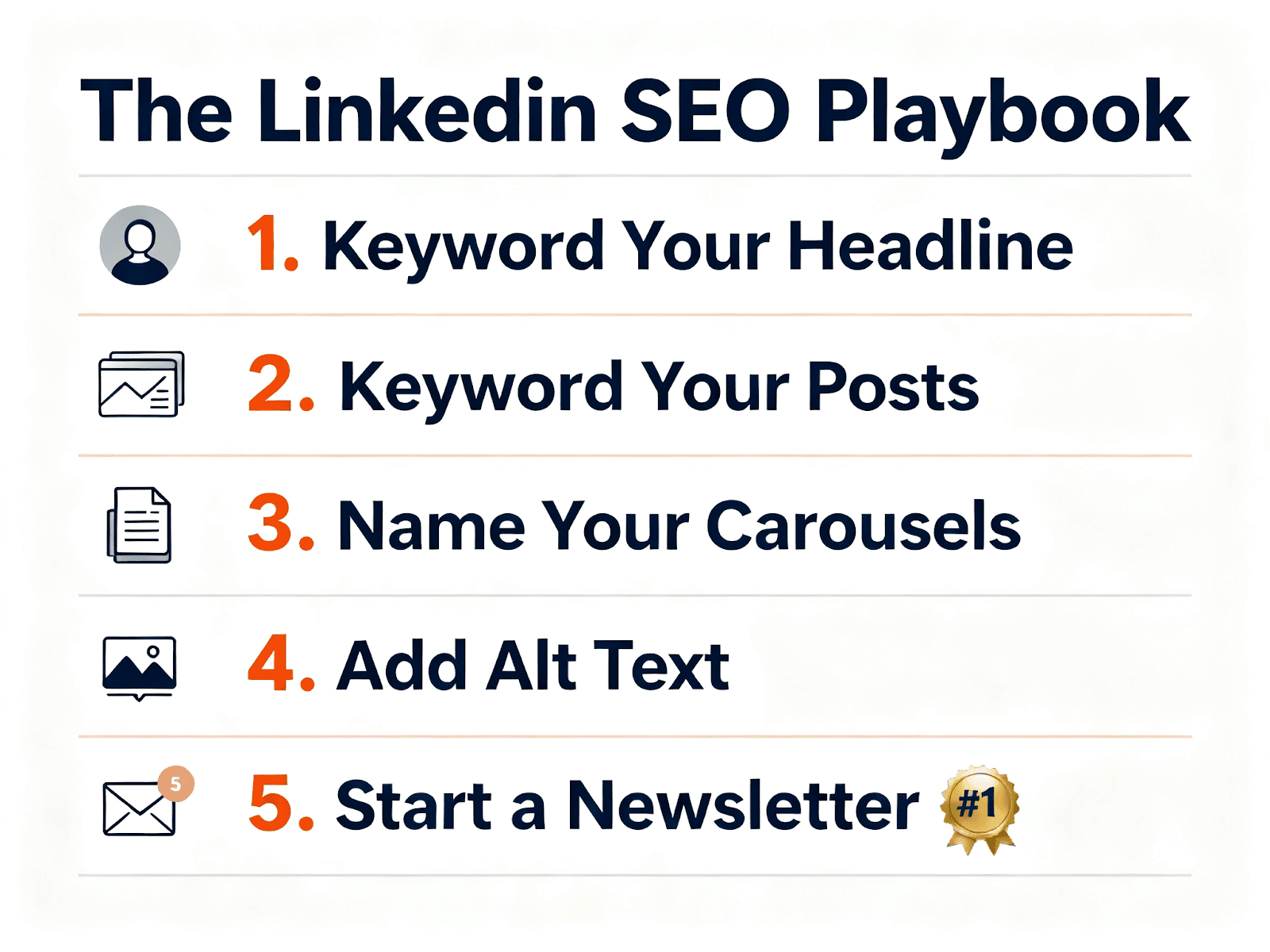
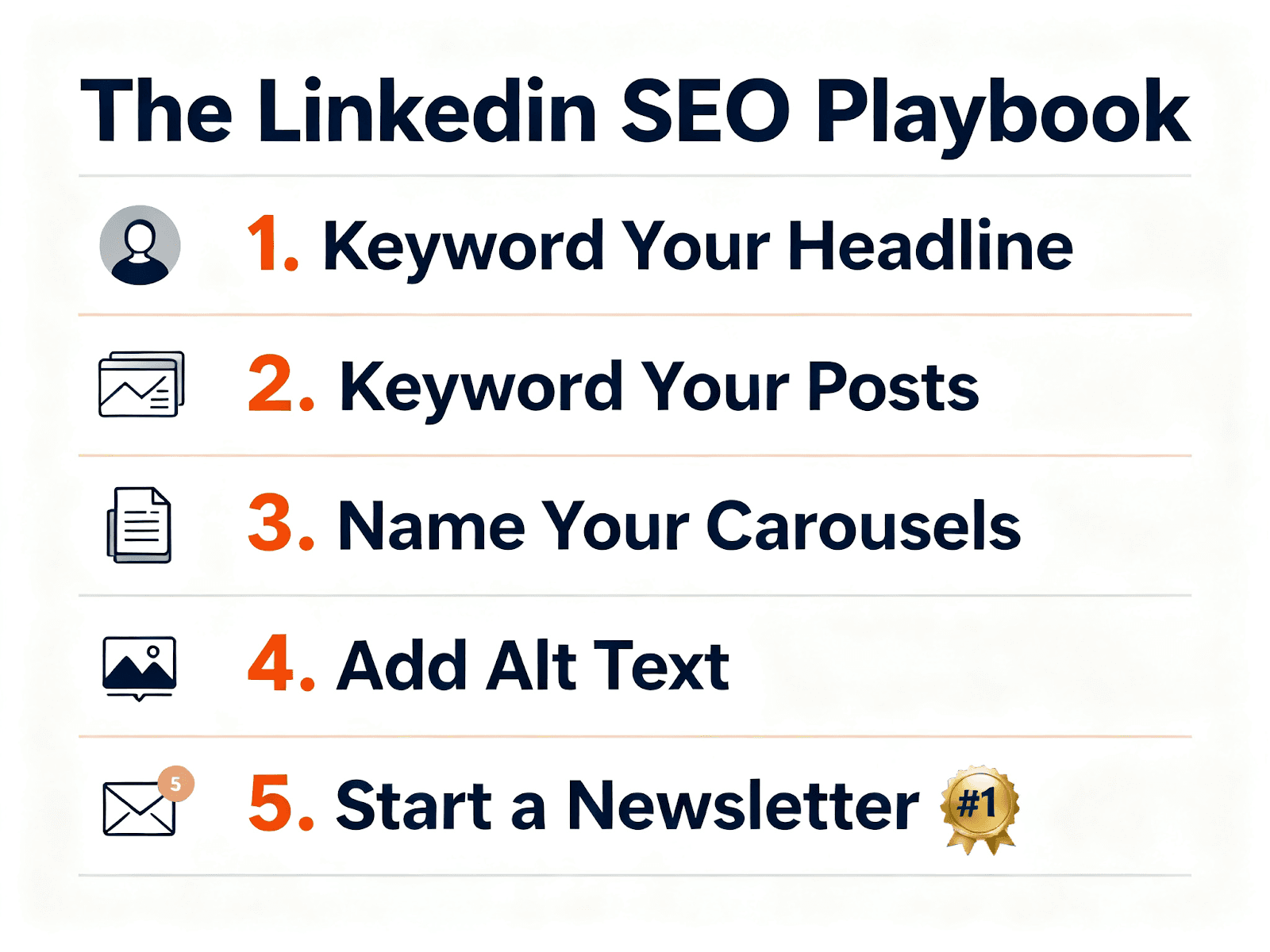
1. Optimize Your Profile for Keywords
Your LinkedIn profile is a landing page. Treat it like one.
Headline - Put your primary keywords here. Not clever taglines. Keywords that your ideal customer would actually search for. If you help B2B SaaS companies with growth marketing, say that.
About Section - This is prime real estate. Weave your keywords naturally into your story. Think about what someone would type into LinkedIn search or Google to find someone like you.
Services Section - LinkedIn gives you a set of predetermined keywords to choose from. You can’t customize them freely, but the list is extensive. Pick every relevant keyword that maps to what you do.
2. Put Keywords in Your Posts
The keywords in your posts matter for three reasons:
- LinkedIn SEO - People searching within LinkedIn can find your posts.
- AI SEO - LLMs are extracting from LinkedIn posts and using them as source material.
- The Algorithm - LinkedIn’s latest algorithm report from their own engineering team says they’re thinking a lot more about topical authority. They show your content to people based on the keywords and topics you consistently write about.
If you always talk about product-led growth, make sure those words actually appear in your posts. Don’t just allude to concepts. Name them.
3. Name Your Carousels Strategically
When you upload a carousel on LinkedIn, there’s a title field at the top. Most people leave it blank or write something generic. Instead, name it with the keywords someone would search for.
A carousel titled “5-Step LinkedIn Content Strategy for B2B Founders” will get indexed differently from one called “My Tips.”
4. Add Alt Text to Your Images
Machines can’t read what’s inside an image. If your most important information is in a designed carousel or infographic, search engines and AI tools are blind to it unless you add alt text.
LinkedIn lets you add alt text to images. Use it. Describe what the image contains using the same keywords your audience would search for. This is a small action that gives you an edge most people ignore completely.
5. Start a LinkedIn Newsletter
This was the insight that surprised me most. Diandra has gotten clients to rank number one on Google using LinkedIn newsletters. Not their company blog. Not a Medium article. A LinkedIn newsletter.
Why? Because LinkedIn has a massive domain authority. A new startup blog might take months or years to build enough authority to rank for competitive keywords. But a LinkedIn newsletter sits on LinkedIn’s domain, which already has that authority baked in.
If your company blog doesn’t have the domain age, the backlink profile, or the topical authority to compete on Google, a LinkedIn newsletter can be a shortcut to page one.
Why Your Viral Posts Aren’t Bringing Revenue?
Diandra shared this from her own experience. Early in her LinkedIn journey, she was getting millions of impressions and hundreds of thousands of views. But she was not making money.
The problem? She was putting all her effort into growth content, the kind of broad, easy-to-engage-with posts that go viral. Posts that are easy to comment on fall into three buckets:
- So basic that anyone can comment - “Great tip!” and clap emojis
- So controversial that people want to argue - Rage engagement
- So celebratory that people want to congratulate you - “Just hit X milestone” posts
These posts get numbers. But numbers don’t pay the bills. As Diandra said, “I was getting 100,000 impressions and 100+ comments. But I didn’t have money in the bank.”
The posts that actually drive revenue are specific, authoritative, and often get less engagement. They might only get 50 reactions instead of 500, but those 50 people are your actual buyers.
This ties directly back to SEO. Someone searching for a specific solution isn’t looking for your hot take. They’re looking for your framework, your case study, your step-by-step guide. Authority content is what ranks. Authority content is what converts.
YouTube: The SEO Play Most B2B Founders Are Ignoring
YouTube is one of the biggest sources for AI and LLMs. It is also the second largest search engine in the world after Google. When someone searches “how to grow on LinkedIn in 2026,” a YouTube video can rank on both YouTube and Google.
But the discovery argument is only half of it. The other half is conversion quality. On LinkedIn, someone scrolls past your post in seconds. On YouTube, they spend 15 to 20 minutes with you. They hear your voice, understand your thinking, and build trust at a depth that a text post simply cannot replicate.
Diandra has seen this firsthand: “The conversion rates of clients coming through YouTube versus LinkedIn were so much higher quality and were so much more convinced already. I didn’t really need to do much convincing.”
If you are already creating content, repurposing it into YouTube is a way to show up in more searches and convert at a higher rate.
Use Keyword Research to Guide Your LinkedIn Strategy
Keyword research is not just for your blog. Your audience has the same problems on every platform. The same questions they type into Google are the topics they want to see on LinkedIn.
Run your keyword research the way you normally would for SEO. Find what your audience is searching for. Then let that research guide what you post on LinkedIn.
This does two things:
- You speak their language - You’re using the exact words your audience uses to describe their problems, not industry jargon they’d never search for.
- You stay consistent across channels - The same narrative shows up on your blog, your LinkedIn, your newsletter, and your YouTube. This is what search everywhere optimization looks like in practice.
Next: Actions for Your LinkedIn
This is what you can do today.
- Check your headline - Does it contain the keywords your ideal customer would search for? Or is it a clever tagline that means nothing to a search engine?
- Review your about section - Read it as if you were a search algorithm. Are your keywords there? Would someone searching for your expertise find you?
- Look at your last 10 posts - Do they contain the keywords you want to be known for? Or are you talking around topics without naming them?
- Add alt text - Go back to your recent image and carousel posts. Add descriptive alt text with your target keywords.
- Consider a LinkedIn newsletter - If your company blog struggles to rank, a LinkedIn newsletter might be the fastest path to Google page one.
SEO isn’t just a website game anymore. Your LinkedIn presence is being indexed by Google, surfaced by AI, and searched by your future customers. Optimize accordingly.

Meet the Author
Paul Jebasingh EmmanuelPaul Jebasingh Emmanuel is the Founder & CEO of GoX.ai, where he is building Two Minute Reports and Illustrations AI. He is passionate about data analytics, automation, and AI, and believes in creating practical tools that make marketers smarter and more productive.