11 Best Reporting Ninja Alternatives for 2026
A detailed list of the 11 best Reporting Ninja alternatives covering features, pricing, use cases, and reporting flexibility to help you choose the right tool.
Reporting Ninja alternatives at a glance
Why limit your reporting to just 20 integrations with Reporting Ninja?
Reporting Ninja is widely used for paid ads reporting and has remained affordable, with pricing unchanged since 2015. This makes it a convenient choice for freelancers, small agencies, and lean data teams.
However, when it comes to enterprise-level reporting, those same strengths become limitations. Reporting Ninja offers fewer than 25 integrations, which can restrict teams managing multiple platforms and growing data sources. While Google Data Studio templates are available, there are no Google Sheets templates, limiting flexibility for teams that rely heavily on spreadsheets.
Customer support is also email-based, which can slow down issue resolution for teams that need faster, more hands-on assistance. As reporting needs grow, these constraints often push teams to explore more scalable alternatives.
That’s where choosing the right reporting tool can help you scale revenue without hitting integration or support limitations.
Why do you need a Reporting Ninja Alternative?
If you’re considering moving away from Reporting Ninja, you’re not the only one. Many marketers, from small agencies to growing in-house teams, reach a point where their reporting needs start to outgrow the tool. After reviewing feedback and common use cases, a clear pattern emerges. Teams want reporting that scales better, offers more flexibility, and fits naturally into their existing workflows. Below are the most common reasons users start exploring Reporting Ninja alternatives.
One-way, email-only customer support
Reporting Ninja relies on an email-based support system, where users need to submit their queries and wait for a response. While this may work for smaller teams, it can feel limiting for growing agencies or in-house teams that need quicker, more interactive support during active reporting cycles.
Limited integrations for scaling teams
With fewer than 25 integrations available, Reporting Ninja can start to feel restrictive as teams expand their reporting stack. As more ad platforms, analytics tools, and data sources come into play, this limitation often becomes a bottleneck for teams aiming to scale their reporting workflows.
Templates limited to Google Data Studio
Reporting Ninja provides pre-built templates only for Google Data Studio. There are no ready-to-use Google Sheets templates, which can be a drawback for teams that rely on spreadsheets for flexible reporting, data manipulation, or client sharing.
Katz E
Their support is terrible. They could not care less about what my problem is.
Top Reporting Ninja alternatives: feature comparison
How Two Minute Reports and 4 other Reporting Ninja alternatives compare on price, AI, client reporting and data, grouped so you can scan what matters to you.
| Compare tools | Two Minute Reports | Power My Analytics | Coupler.io | Dataslayer | Portermetrics |
|---|---|---|---|---|---|
| Starting priceCheck the unit: per month, account or client | $81/mo | $41.63/mo | $24/mo | $35/mo | $12.50/account |
| Best forWho each tool suits most | Multi-client agencies | Data Studio users | Midsized agencies | Enterprise teams | Freelancers |
| Feature coverageAcross the 15 features below | 15 of 15 included | 3 of 15 included | 6 of 15 included | 2 of 15 included | 5 of 15 included |
| AI & automation | |||||
| AI agentAsk questions about your data in plain English | Included: Dash AI Agent | Not available | Partial: Credit-capped | Partial: $115+ plan | Not available |
| AI dashboard builderBuild a dashboard from a prompt | Included: No credit caps | Not available | Not available | Not available | Not available |
| MCP (Claude, ChatGPT)Part of your plan, or bought as a separate destination | Included | Included: Included, shared API quota | Included | Partial: Separate paid destination | Included |
| Claude SkillsReady-made reporting workflows in Claude | Included | Not available | Included: Available via MCP | Not available | Not available |
| Client reporting | |||||
| Scheduled briefingsAuto-email clients a summary of their dashboard | Included | Not available | Not available: Not available | Not available | Not available |
| Goals & budget pacingTrack targets and spend against budget | Included | Not available | Not available | Not available | Not available |
| White-label reportsReports under your agency's brand | Included | Not available | Included | Not available | Partial: Via Data Studio |
| Custom domainHost reports on your own URL | Included | Not available | Not available: Not available | Not available | Not available |
| Data speed & reliability | |||||
| Hourly data refreshOn every plan, or only on pricier plans and add-ons | Included: Unlimited refreshes | Partial: Paid add-on, daily by default | Partial: $199+ plan, daily on Starter | Partial: $115+ plan, daily on Starter | Included: Hourly, daily, weekly |
| Load reports fasterData is pre-loaded, so reports open quickly | Included: 5x faster with Speedboost | Partial: Warehousing, manual backfill | Included: Built-in warehousing | Included: Warehouse caching | Not available: Slows on high-volume accounts |
| Data sourcesNumber of built-in connectors | 30+ | 40+ | 300+ | 40+ | 20+ |
| Data tools | |||||
| Data blendingCombine several sources in one report | Included | Included | Included | Partial: $115+ plan | Included |
| Custom fieldsCreate your own metrics and dimensions | Included | Partial: Beta | Included | Included | Included |
| API accessPull your data into other tools | Included | Included: Included, with quotas | Partial: $99+/mo (Active plan) | Partial: Paid destination | Not available |
| Team & switching | |||||
| Team seatsUsers included at no extra cost | Included: Unlimited | Not available: Paid seats | Partial: 1 user on Starter | Not available: 1 user | Included: Unlimited |
| Migrate existing reportsRebuild an old report from a PDF or screenshot | Included: AI rebuild from PDF | Not available | Partial: Onboarding: Custom plan | Partial: Supermetrics queries only | Not available: Setup call only |
| Reviews | |||||
| G2 ratingScore out of 5. Tap a score to read the reviews on G2 | 4.8Read reviews on G2(opens in a new tab) | 4.5Read reviews on G2(opens in a new tab) | 4.8Read reviews on G2(opens in a new tab) | 4.8Read reviews on G2(opens in a new tab) | 4.6Read reviews on G2(opens in a new tab) |
| Try for Free | Learn More | Learn More | Learn More | Learn More |
Top 11 Reporting Ninja alternatives for agencies, marketers, and data teams
Here are the top-performing Reporting Ninja alternatives on the market you can switch to today.
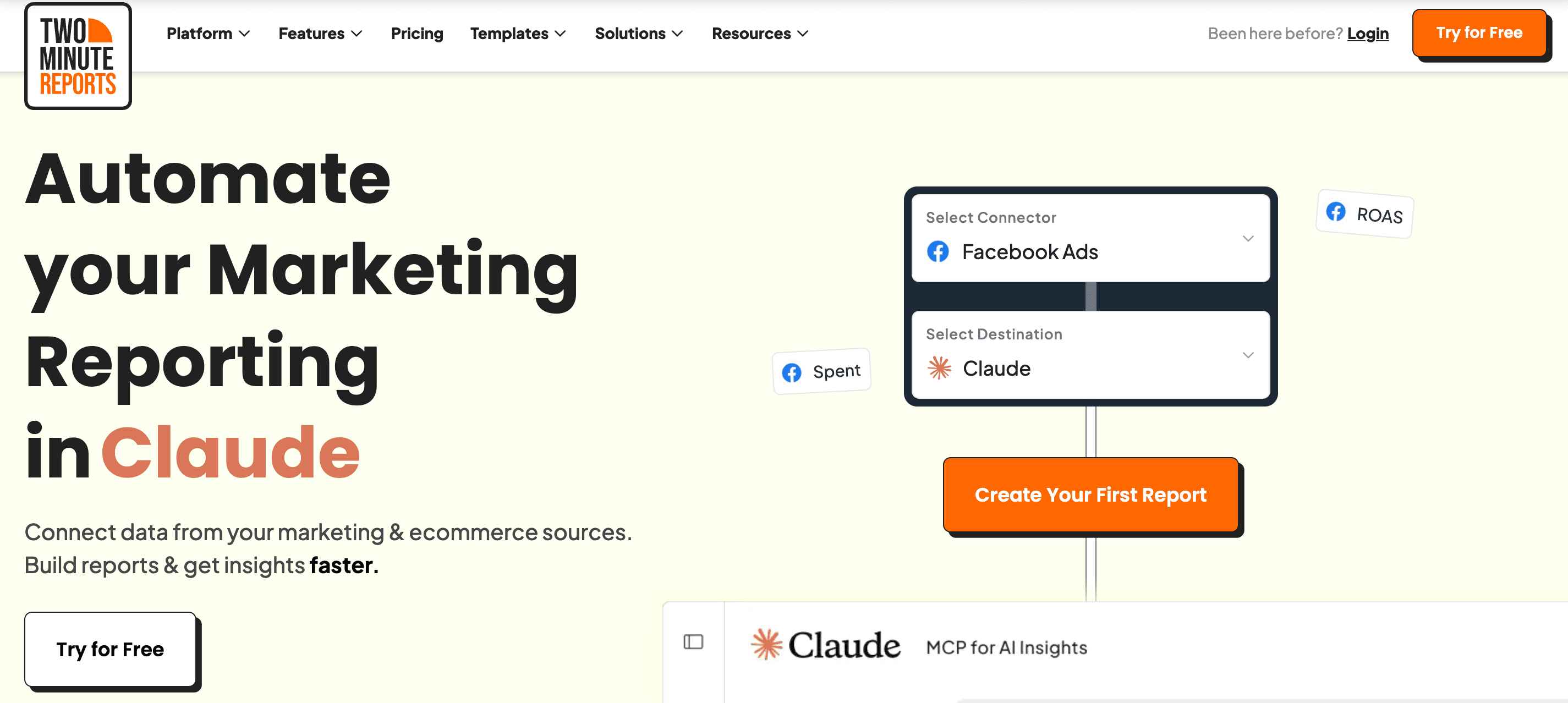
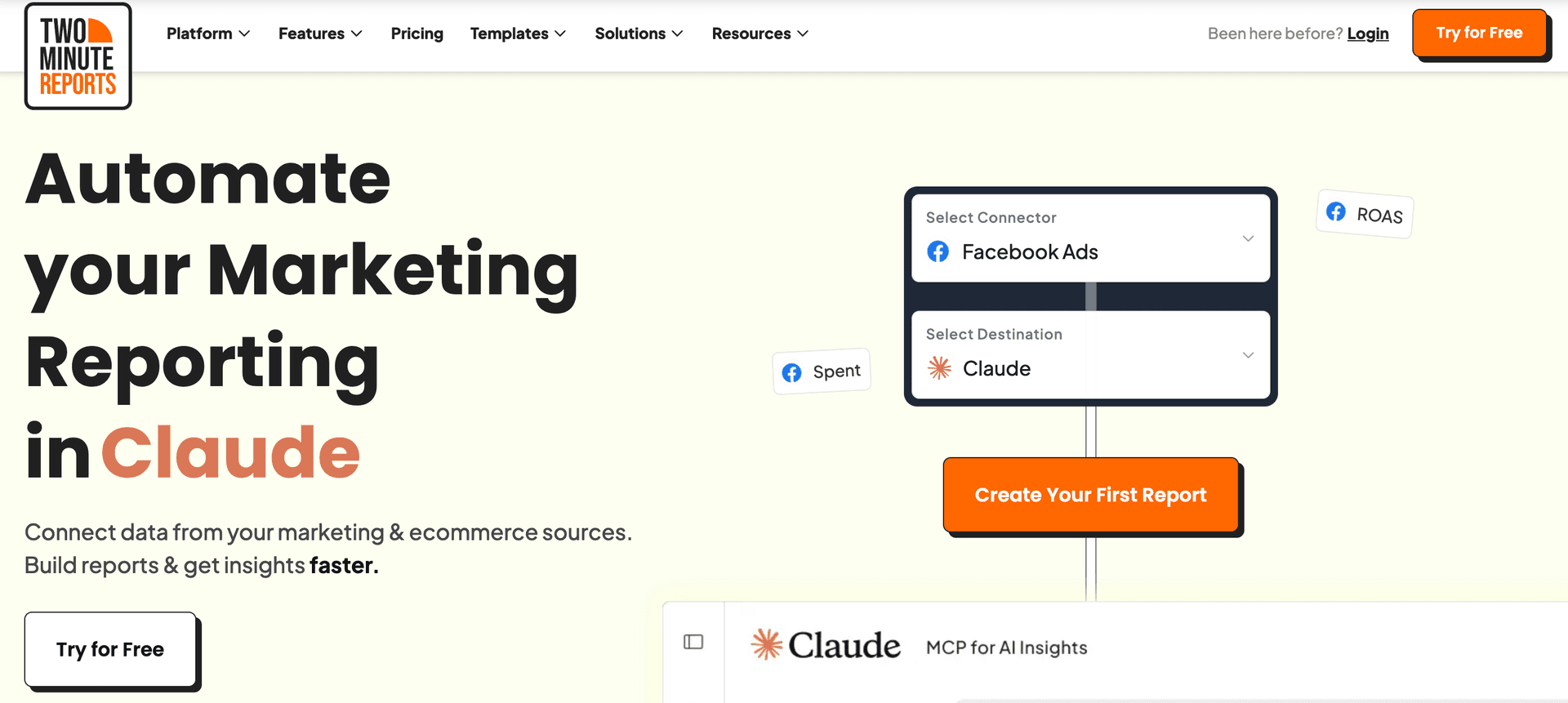
1. Two Minute Reports
Best for:
Multi-client agencies and marketing teams looking for AI-powered marketing intelligence.
Integrations:
Supports 30+ data sources, including Facebook Ads, Shopify, Google Ads, Google Analytics, LinkedIn Ads, Amazon, etc.
Key features:
- AI Dashboards - describe the report you want and get a live dashboard for any connected data source.
- Dash AI - An all-in-one AI marketing agent that lets you chat directly with your campaign data.
- 100+ free pre-built templates - ready-made, client-ready dashboards for every major channel
- White-label marketing reports - your logo, your colors, your branding, on every plan.
- Automated scheduled reports - scheduled report delivery across multiple clients via email.
- Speedboost technology - large dashboards load faster, so you spend less time waiting on refreshes.
- Data blending - blend data across PPC platforms into one, clear ROI-focused view.
- Custom fields - build metrics and dimensions that match your own business logic.
- Goals and budget tracking - set targets, pace spend, and flag overspend before the month closes.
- Client management & account mapping - group ad accounts by client so multi-client reporting stays tidy.
- MCP Access - connect your marketing data straight into Claude, ChatGPT, and other AI platforms
- Claude Skills - download ready-made audit skills and run a full account review in minutes.
- Easy learning curve.
- No-code, automated reporting with transparent, scalable pricing.
- Faster data syncs to streamline reporting workflow.
- Responsive customer support
- Zero row limits across all plans.
- Build AI dashboards faster without any caps or limits
- Automate performance summaries to your clients on set intervals via Dash AI.
- Hourly refresh available across all plans.
Jakub
"Its ease of use, coupled with its ability to integrate with popular platforms like Google Analytics and Facebook Ads, makes it an attractive option for businesses and agencies that need a reliable reporting solution without a steep learning curve."
- No freemium plan.
David
"There are some integrations that could be added to make it more robust."
First-Hand Experience
Two Minute Reports feels much quicker to get started with compared to Reporting Ninja. Connecting data sources and pulling key metrics into Google Sheets or Google Data Studio requires minimal setup, which is crucial when managing reports across multiple clients.
As reporting needs grow, the contrast becomes clearer. Reporting Ninja works fine for basic dashboards, but it starts to feel restrictive when you need more integrations or faster performance at scale. With Speedboost in place, large reports and blended datasets in Two Minute Reports load almost instantly, cutting down the usual wait time during reviews or optimizations.
Support also makes a noticeable difference. When something needs clarification or a report setup needs adjustment, help is responsive and practical with Two Minute Reports. You are not left digging through docs or waiting days for answers.
Day to day, this adds up to less time fixing reports, less time waiting on data or support, and more time actually using insights to make decisions.
Pricing and Value
Annual billing saves 17%.
Final Verdict
Two Minute Reports clearly outshines Reporting Ninja where it matters most: scale, performance, and reporting flexibility. With broader integrations, faster data refresh through Speedboost, and fully white-label reporting available without restrictive tiers, it removes the friction that slows teams down as reporting needs grow.
It gives agencies and marketers the ability to manage multi-client reporting smoothly, handle large datasets without delays, and automate workflows without worrying about integration caps or performance bottlenecks. In short, Two Minute Reports delivers a more scalable, faster, and future-ready reporting experience than Reporting Ninja.
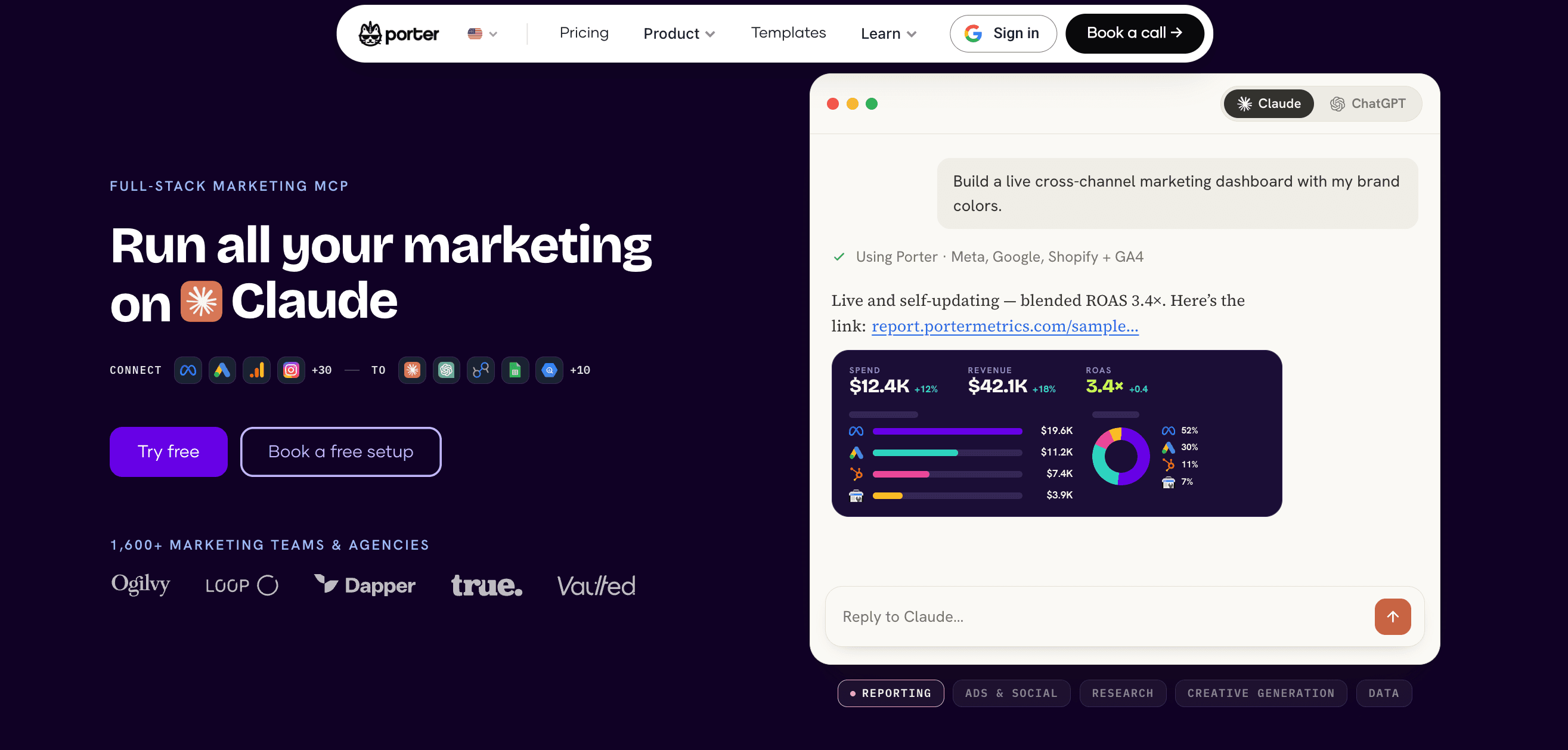
2. Portermetrics
Supported platforms:
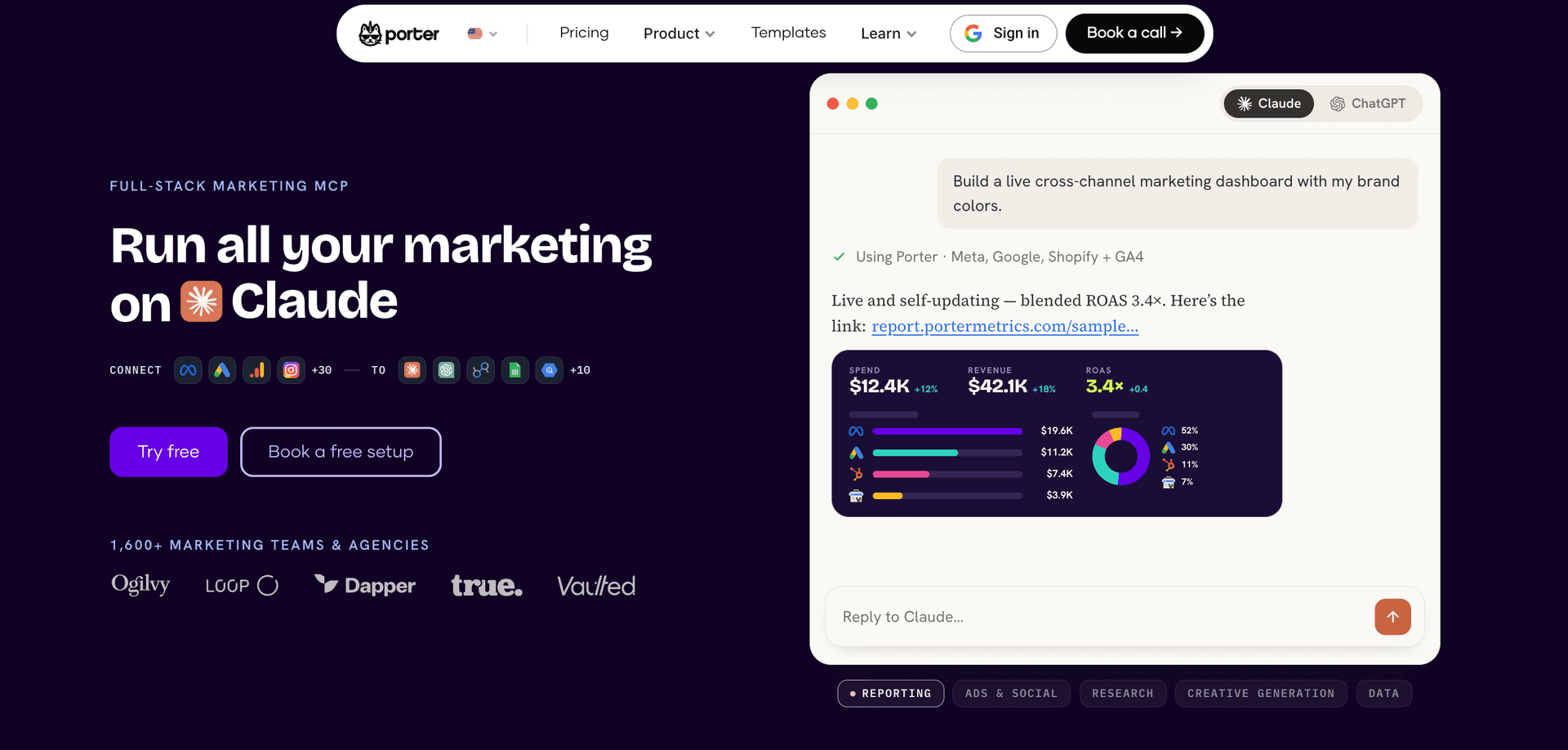
Offers 20 marketing-focused integrations across ads, social media, CRM, ecommerce, email, etc.
Key features:
- Data source integration: Syncs marketing data from 18+ platforms, including Google Ads, Meta Ads, LinkedIn, Shopify, HubSpot, and Mailchimp in one place.
- Build client reports: Let's non-technical users build visual reports using drag-and-drop elements like charts, scorecards, and tables.
- Automated reporting: Automates report refresh and delivery on a daily, weekly, or monthly basis to keep teams updated.
- Cross-channel reporting: Blends data from multiple sources to measure performance metrics like ROI and ROAS across channels.
- Custom marketing dashboards: Builds shareable dashboards in Google Data Studio and Google Sheets for easy access across teams.
- AI creative generation: Generates advertising images, product visuals, videos, etc using AI models through conversational workflows.
- Offers 100+ ready-to-use templates for Google Data Studio and Google Sheets.
- Known for its beginner-friendly interface that makes reporting simple even for non-technical teams.
- Supports cross-channel reporting to give a complete picture of marketing performance.
- Flexible pricing lets you pay only for the accounts you actually connect to and use.
- Great for teams who want powerful analytics with no-code or complicated setup.
Walter F
"Without a doubt, the quick and easy connection allowed me to create a dashboard in minutes, taking advantage of the available themes, replicating charts and tables according to my needs, without worrying too much about the design."
- Dashboards can take longer to load, which may slow down reporting workflows.
- A limited number of integrations makes it less scalable for multi-channel teams.
- Pricing isn’t the most competitive, especially given the smaller connector library and no free plan option.
- Advanced capabilities like data blending require an additional paid add-on.
- Better suited for Google Data Studio; Google Sheets users may find the functionality restrictive.
George R
"The connectors are always broken and it is always an error on the Porter Metrics end. It makes it extremely frustrating when I make reports for senior management and in the middle of their presentation Porter's connectors break and it looks bad on everyone. "
First-Hand Experience
Using PorterMetrics gave me a clear sense of speed and simplicity from the start. Connecting accounts and sending data into Google Data Studio or Google Sheets was quick, and I didn’t need technical help to get reports up and running. Many small to midsize teams like it because it lets you start generating dashboards without wrestling with complex setup steps.
Over time, PorterMetrics feels predictable in performance. It does what it says: pulls data reliably so you can focus on the analysis side of reporting. The interface does not get in the way, and templates help speed up recurring workflows. That means fewer late nights fixing or rebuilding reports before client meetings.
However, there are trade‑offs. PorterMetrics doesn’t centralize or transform large datasets in the way some heavier tools do. When your reporting needs span multiple ad platforms, analytics sources, and web data, you’ll often still do the heavy data work in your destination tool. In those scenarios, the tool feels more like a bridge than a full reporting platform.
Pricing and Value
Portermetrics offers two separate pricing plans:
- Reporting: Follows a pay-per-account pricing model. Starts at $12.50/month per account. Pricing becomes expensive as you add more accounts.
- Automation: The free plan offers 100 credits/month. The Build plan starts at $23/month for 500 credits/month and goes up to $208/month, allowing up to 10,000 credits/month.
Final Verdict
PorterMetrics stands out for teams that want fast, reliable data flows into familiar reporting destinations. It delivers consistent performance without a steep learning curve, and it handles most common marketing sources without fuss.
Reporting Ninja, by comparison, leans more into built‑in dashboard creation and automated client sharing. It’s easy to set up simple dashboards and distribute branded reports, but its integration library is smaller, and users sometimes mention speed and flexibility issues, especially when scaling with many clients or large datasets.
If your focus is on predictable, destination‑ready data pipelines and clean reporting workflows, PorterMetrics feels like the more flexible fit.
3. AgencyAnalytics
Supported platforms:
Supports 80+ integrations such as ActiveCampaign, Amazon Ads, LinkedIn Ads, GA4, etc.
Key features:
- White-labelling: Offer clients branded, professional dashboards to improve your agency’s expertise and credibility.
- AI-Tracker: Track and analyze how your clients show up across different AI platforms such as Claude, ChatGPT, Gemini, etc.
- Clients & Staff Management: Manage all your clients, staff, and teams in one place so you can share reports, create custom permissions, and give clients their own login.
- Drag-and-drop report builder: Use the drag-and-drop report builder to create visually compelling reports that showcase clear results.
- Custom comments: Add personalized comments and annotations to make your reports contextually relevant to your clients.
- Easy-to-use reporting interface.
- A broad range of integrations for agencies to consolidate marketing data.
- Fast and responsive customer support.
Oren M
"The platform gives you complete visibility into performance across multiple channels, with advanced filtering options and fully customizable dashboards."
- Some users face issues with the rank tracker.
- Pricing scales as you onboard new clients.
Sarfaraz
"The platform had limited capacity when it came to configuring report dimensions and tracking custom dimensions, which severely limited my ability to gain the insights I wanted from our performance reports. Furthermore, there were quite a few occasions where I encountered bugs in their software or had difficulty getting technical support for my issues."
First-Hand Experience
AgencyAnalytics feels solid out of the box for agencies that want clean, client‑ready dashboards without heavy technical setup. From the first login, connecting analytics and ad accounts is simple enough, and setting up recurring email reports saves time on manual exports. Users often praise its intuitive interface and visual data representation, which helps teams present insights clearly to clients.
Where AgencyAnalytics starts to show limitations is in customization and scale. Some users report that layouts and widgets can feel rigid, especially when deeper multi‑source blending or highly tailored dashboards are needed. As reporting needs grow, handling complex data models or custom metrics may take extra work outside the platform.
Customer support is frequently highlighted as a strong point. Agencies report responsive help and guided onboarding, which is reassuring when reports need to be right the first time. That makes day‑to‑day use less stressful, even when you push the tool toward higher‑volume reporting.
Pricing and Value
AgencyAnalytics pricing depends on the number of clients.
- Core plan: $20/month for one client (billed annually)
- AI Tracker (add-on): $20.83/month per 250 credits (currently in Beta)
- Rank-tracker (add-on): $41.67/month per 500 keywords.
Final Verdict
AgencyAnalytics performs reliably for basic reporting workflows, but its pricing and customization limits can feel restrictive as teams scale. Custom widget layouts and advanced data blending are often locked behind higher plans, and agencies with larger client portfolios may see costs rise faster than expected. It remains a capable choice for straightforward reporting and teams that value ease of use.
4. Coupler.io
Supported platforms:
Supports integration with 300+ data sources across a wide range of categories such as CRM, ecommerce, email, marketing, social media, etc.
Key features
- Data blending: Consolidate and streamline key advertising channels in a single dashboard.
- Data transformation: Apply advanced filters and sorting options to clearly visualize actionable insights.
- Custom formula fields: Create formula fields and perform calculations using the Transform module.
- AI-insights: Get instant insights from your dashboard data powered by AI.
- AI Agent: Ask questions related to your campaign performance and act on the insights to make informed decisions.
- SQL-powered data transformation: Combine, reshape, rank and compare datasets using custom DuckDB SQL queries for flexible control over data preparation.
- Automatically launch data imports.
- Responsive support team.
- Customize data flows to your specific business needs.
Norman D
"I’ve found Coupler to be an invaluable tool for our operations. We are using it to create a single view across multiple QuickBooks Online (QBO) and Stripe instances, giving our organization unified reporting that was previously very difficult to achieve. "
- Must upgrade to higher plans for daily refreshes and unlimited data volume limits.
- Some users find it difficult to set up complex integrations.
- Lacks advanced data transformation capabilities.
First-Hand Experience
Coupler.io impressed me from day one with how easy it made consolidating data for reporting. Setting up data pipelines felt approachable even without heavy technical expertise, and I was able to automate scheduled imports into Google Sheets or BI tools in minutes. Users often highlight that it saves hours of manual work by keeping dashboards up to date without daily exports or manual refreshes.
The interface stays straightforward as needs grow. Filtering, merging, and transforming data before sending it to destinations gives teams control over what lands in their reports without complex ETL scripting. Support interactions were positive, with quick and helpful responses that made onboarding smoother than expected.
That said, Coupler.io’s strength is its simplicity and automation focus. For extremely heavy transformation logic or advanced data modeling, you might still need a separate BI platform or scripting environment. But for most reporting use cases, the platform hits a sweet spot between capability and usability.
Pricing and Value
Coupler offers a free plan with 1 data source, 1 user, 1 destination and 100 rows/run. The paid plans are as follows:
- Starter: $24/month – 3 accounts, 1 destination, daily data refresh, 5000 rows/run, transformations, AI Agent (900 credits) and AI insights (5 credits)
- Active: $99/month – 15 accounts, 3 data destinations, daily data refresh, AI analysis (AI Agent (1500 credits) and AI insights (25 credits))
- Pro: $199/month – 50 accounts, hourly data refresh, AI analysis (AI Agent (3000 credits) and AI insights (100 credits))
- Custom: Custom Pricing – Custom accounts and destinations
Final Verdict
Coupler.io stands out when your priority is straightforward, automated data integration and scheduled reporting. It lets teams pull data from many sources into Google Sheets, Google Data Studio, or other destinations with minimal setup and reliable automation.
If your goal is to build dependable, automated data workflows with flexible destinations and low setup friction, Coupler.io delivers a more adaptable experience. It gives teams broader automation and data control without compromising ease of use.
5. Adverity


Supported platforms:
Access to 600+ connectors across a wide range of categories, such as ad server, affiliate, attribution, CRM, database, social analytics, marketing automation, SEO, etc.
Key features:
- Data Harmonization: Standardize metrics and dimensions across platforms using data mapping, so fields such as cost and spend can be compared consistently.
- AI-powered transformation assistance: Use Transformation Copilot to identify suitable transformations and help configure custom scripts, including Python and RegEx expressions.
- AI-ready marketing data: Adverity Atlas adds a marketing knowledge layer to an existing data warehouse, so that AI tools can better interpret metrics and KPIs to help you make better decisions.
- Data quality monitoring: Detect data issues and anomalies before they affect your reporting and analysis.
- Robust data management capabilities.
- Efficient pipeline management.
- Automated data monitoring helps fix issues quickly.
- Manages historical data for long-term analysis and data warehousing.
Nicolas C
"We run thousands of pipelines on Adverity and it handles them very well. Performance is strong and the platform is highly flexible , we can customize pipelines to fit our exact needs, which makes managing lots of different data sources much easier."
- Some data streams take time to fetch.
- Steep learning curve for non-tech users.
- Visualization and customization options can be improved.
- Limited white-labelling options.
Beatriz M
"The complexity of the platform regarding the rules that you can add and the technical part. When you need to create a Bundle in order to have several datastreams connected. "
First-Hand Experience
Adverity feels like stepping into a solid data engine rather than just a dashboard builder. From the first connection, you notice it brings more structure to reporting data. Pulling in information from multiple sources felt consistent and reliable, and the system normalized metrics automatically so things added up across channels. Users often say this saves them time cleaning data before reporting.
Working with larger volumes of data does not slow it down. Even when I added several ad platforms, analytics tools, and CRM sources, the interface stayed responsive and the reports stayed accurate. This was useful in multi‑client environments where consistency matters.
That level of power does mean a learning curve. If your reporting needs are straightforward, the setup feels heavier than simple dashboard tools. You need to think about data flows and mapping early on. But once that foundation is in place, the payoff is cleaner, more trustworthy reporting.
Pricing and Value
Since Adverity is focused towards large-scale enterprise reporting, they have custom plans. You must contact their team to enquire about plans.
Final Verdict
Adverity delivers strength when data consistency and multi‑platform scale matter most. It cleans and aligns data before it reaches your reporting layer, reducing manual corrections and mismatches. This gives teams confidence in the numbers they share with stakeholders.
If your priority is deep data integrity across many sources and scalable reporting for complex campaigns, Adverity gives you a sturdier foundation.
6. Dataslayer
Supported platforms:
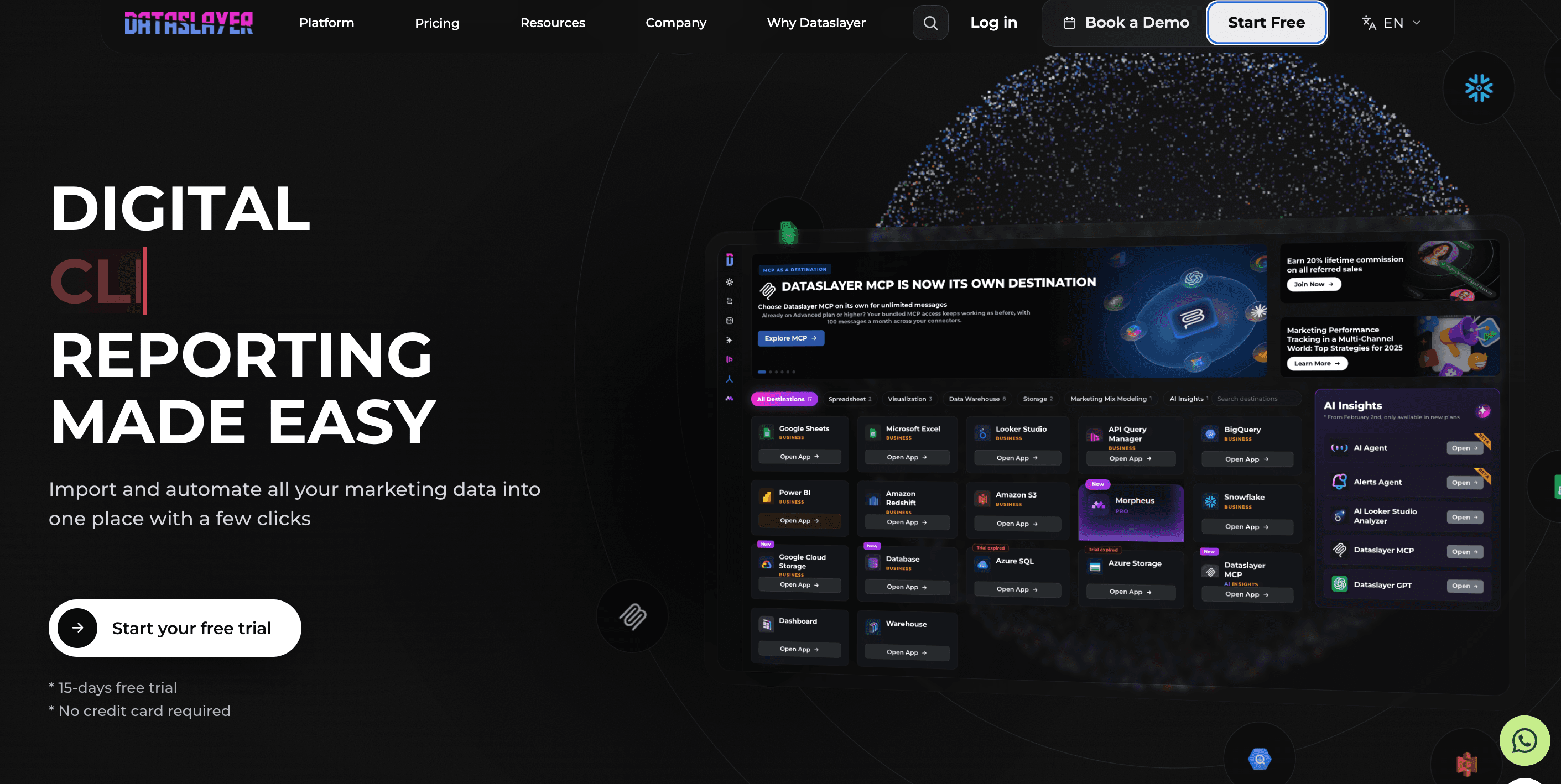
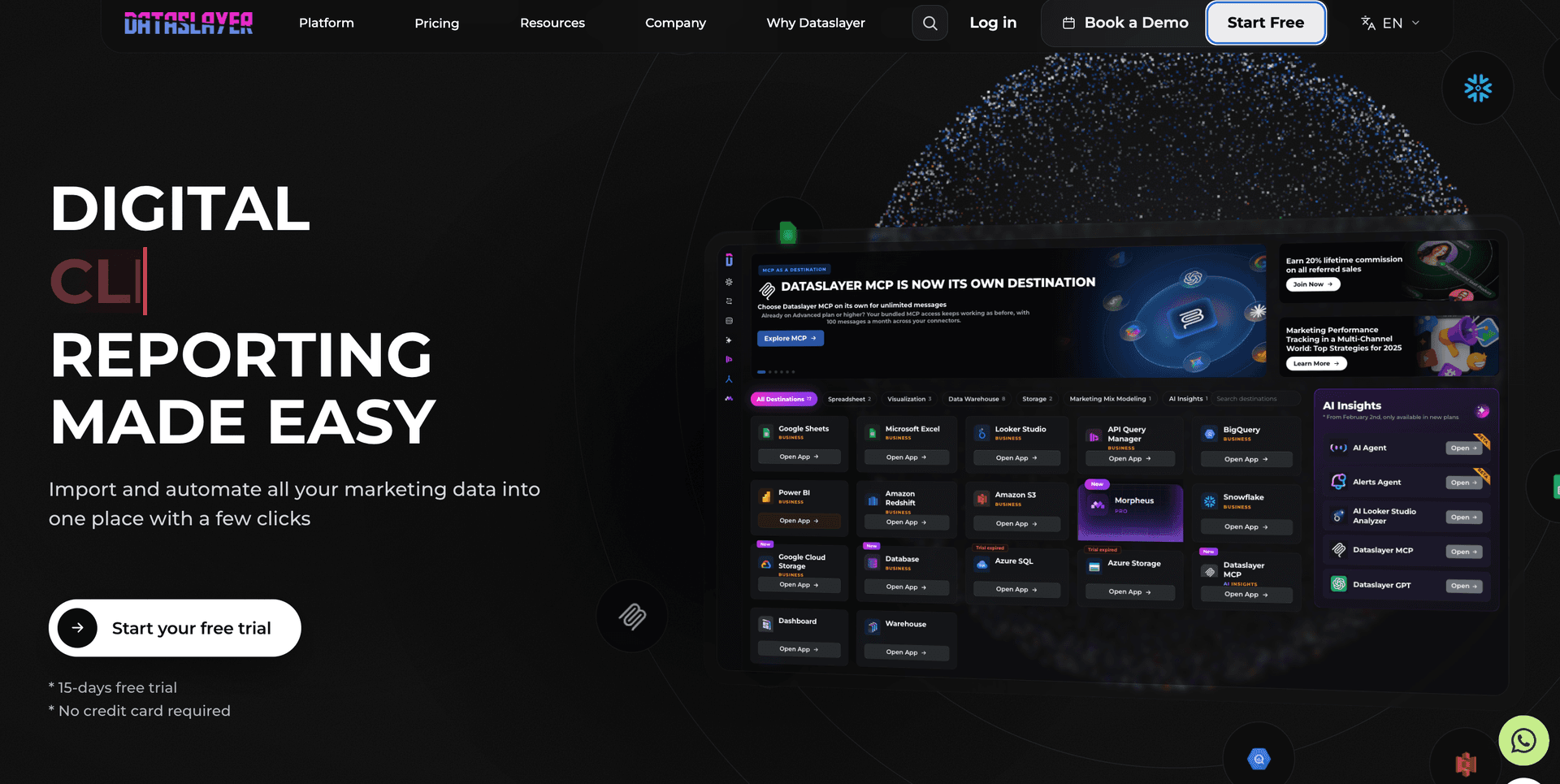
Supports 50+ platforms such as Facebook Ads, Google Ads, GA4, YouTube, Snapchat, MariaDB, Stripe, WooCommerce, etc.
Key features:
- Data integrations: Connect data from different advertising, CRM, analytics, and ecommerce platforms.
- Dataslayer GPT: Access to Dataslayer AI for smarter and easier workflows.
- Automated report delivery: Schedule automatic refreshes to deliver live, real-time updates to clients.
- Data destinations: Export data to warehouses like BigQuery and Snowflake for sophisticated analysis.
- Marketing Mix Modeling: Optimize your advertising campaigns by forecasting data with Morpheus.
- Intuitive dashboard to streamline PPC reporting.
- Responsive customer support.
- Stable connections ensure smooth data analysis and reporting.
Rony D
"Dataslayer is an efficient, accessible, and easy-to-implement tool. It allows marketing teams to focus on analyzing and optimizing campaigns, instead of wasting time on repetitive data export tasks. "
- Certain metrics and dimensions may require manual adjustments.
- Must upgrade to higher plans for flexibility in API calls and daily refresh.
Daniel P
"Scalability: As user needs grow, enhancing scalability options for larger datasets and more complex queries could be beneficial."
First-Hand Experience
Dataslayer immediately stood out as a practical way to automate data consolidation without a lot of technical setup. Connecting multiple paid marketing sources and pushing data into tools like Google Sheets or Google Data Studio felt intuitive and fast, which helped cut down the time spent pulling numbers manually each week. Users regularly praise its intuitive interface and reliable scheduled reports that keep workflows moving.
As I expanded the number of data sources, Dataslayer kept pace without much hassle. Its automation meant dashboards stayed up to date and team members could focus more on insights than exporting or refreshing data. Many users also highlight responsive support, which makes onboarding and troubleshooting smoother.
That said, Dataslayer is not without its trade‑offs. Some connectors can miss specific metrics or require manual adjustments, and data loads occasionally slow down with large datasets. Users also note a moderate learning curve for advanced reporting setups.
In practice, this means Dataslayer feels strong for most marketing reporting needs, but teams that need extensive, complex data manipulation or fully unified BI workflows may find themselves supplementing with external tools.
Pricing and Value
Dataslayer offers freemium plans. Its free plan includes 1 connector, 1 user, 1 account and manual data refresh. The paid plans are as follows:
- Starter – $35/month – 3 connectors, 1 user, 1 destination, 3 accounts per connector, daily schedule
- Advanced – $115/month – 7 connectors, 10 users, 50 accounts per connector, 1 destination, hourly schedule. data blending, AI insights (100 messages for AI insights and 100 calls for other AI features)
- Pro – $345/month – 10 connectors, 1 destination, unlimited users, 100 accounts per connector
- Business – Custom – Custom connectors of your choice, hourly refresh and custom hours
You can choose from Core, Enterprise, and MCP destinations. The Enterprise destinations include a monthly row limit.
Final Verdict
Dataslayer shines when you want reliable data automation and multi‑platform reporting without constant manual effort. It lets you pull data from many sources and keep destinations refreshed automatically, which saves time every reporting cycle.
If your priority is automated, dependable data flows into tools you already use while keeping reports up to date with minimal effort, Dataslayer delivers a strong experience.
7. Power My Analytics
Supported platforms:
Supports 40+ platforms such as Google, Facebook, Instagram, Shopify, HubSpot, Campaign Monitor, Outbrain, etc.
Key features:
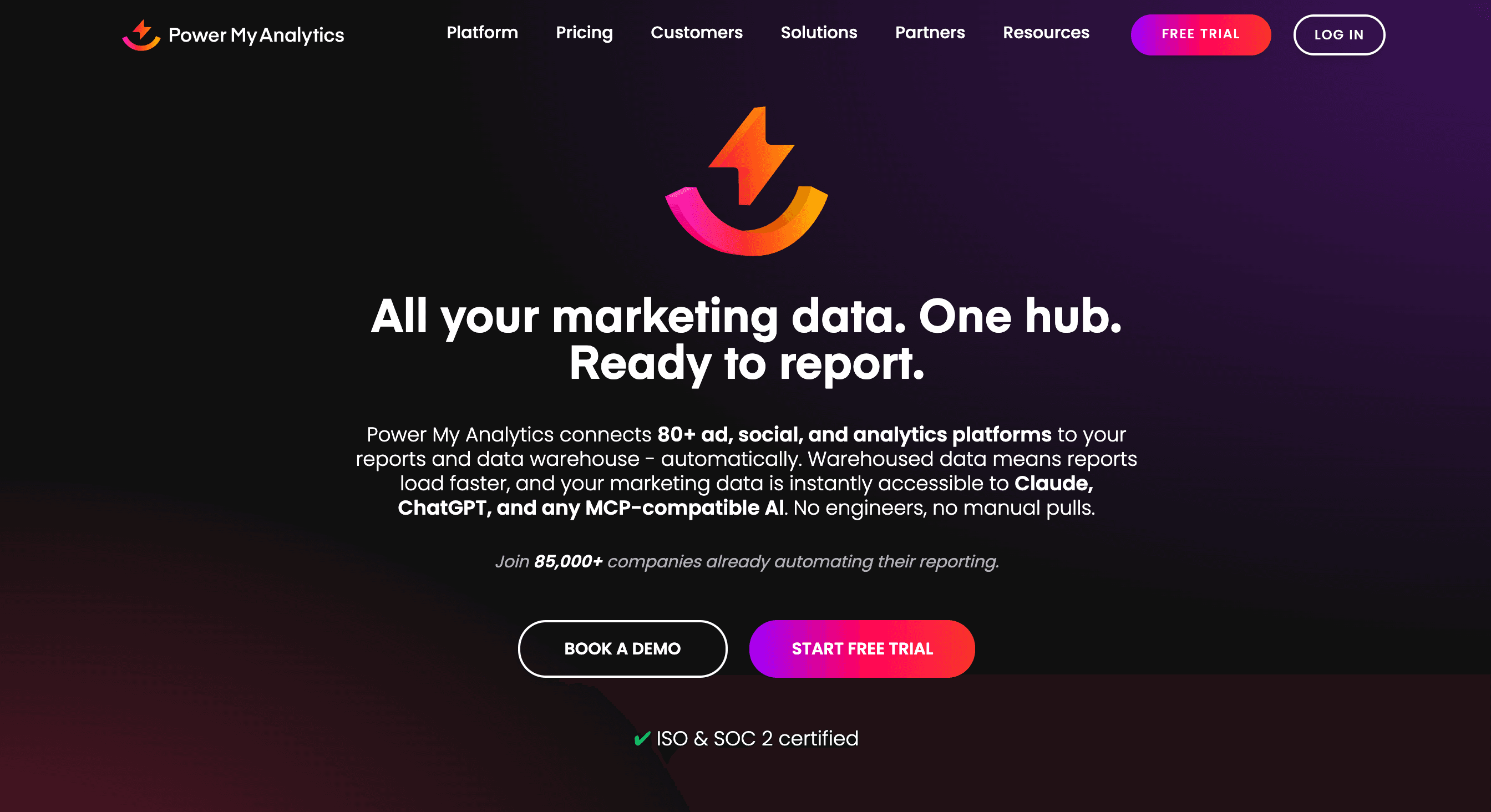
- Marketing Data Hub: Connect your marketing platforms to your preferred destination, warehouse or spreadsheet tools.
- Data Warehousing: Automatically collect and store marketing data in PMA’s data warehouse, helping you centralize your data for maximum efficiency.
- AI-insights: Generate AI-summaries of datasets to identify performance trends, anomalies, top-performing campaigns, etc. AI insights uses monthly credits which is based on your plan.
- MCP Integration: Connect marketing data to AI tools such as Claude, ChatGPT through MCP to act on your insights instantly.
- Easy-to-use interface with the ability to consolidate multiple data sources.
- Flexible warehousing solutions to store and secure your data.
Jens O
"Power My Analytics offer an easy integration with our data source(s) and was quickly deployed via predefined templates that gave a nice overview of most important KPIs."
- You can build unlimited reports in Google Sheets only on higher plans.
- Pricing feels expensive for SMBs, especially with increasing add-on costs.
Rebecca
"The connectors do seem to need some work--they can sometimes be slow, or the metrics are not always obvious for the various connectors. "
First-Hand Experience
Power My Analytics impressed me with how quickly it pulled multiple data sources into a single workflow. Setting up connectors was intuitive, and once linked, the automation kept dashboards refreshed without manual intervention. Many users appreciate how it simplifies routine reporting tasks that would otherwise eat into the week.
I noticed that scheduled reports and pre‑built outputs save time, especially when pulling metrics into Google Sheets or Google Data Studio. This feels especially valuable for teams that juggle several clients and need their data ready without constant checking. The pricing also tends to be friendlier than bigger enterprise tools, which is a big plus for lean teams.
That said, it is not perfect for every scenario. Some reviewers note occasional connector quirks or a learning curve around advanced setup, and support experiences vary. A few users on review sites have expressed frustration when data syncs fail or when support is slow.
In practice, this means Power My Analytics delivers reliable automation for many common reporting needs, but teams with super complex data or mission‑critical SLA requirements may find occasional bumps along the way.
Pricing and Value
PMA offers 4 pricing plans. All plans include access to Data Studio, Tableau, Claude, ChatGPT, and Power BI. Here they are:
- Business: $41.63/month – 5 sources, 5 total accounts, 50 AI Insights credits
- Grow: $83.29/month – Unlimited sources, 7 accounts/source, 100 AI insights credits
- Pro: $166.63/month – Unlimited sources, 20 accounts/source, 100 AI insights credits, Sheets/Excel integration
- Custom: Contact Sales – Export to BigQuery, SQL, FTP, unlimited sources/accounts
Final Verdict
Power My Analytics earns its place as a strong choice for teams that want reliable, automated data flows without heavy technical setup. It pulls data from many sources and keeps destinations updated, which frees up time that would otherwise go into manual report assembly.
Some users also report slower performance with larger datasets or constraints around advanced connectors. If you need broader data automation and fewer manual steps, Power My Analytics stands out.
8. Funnel.io


Apps:
Available as a Google Sheets add-on, Google Data Studio connector, and includes destinations by use cases.
Supported platforms:
Supports 100+ platforms such as Facebook Ads, Instagram insights, Bing Ads, Amazon Ad Server, Taboola, Shopify, WooCommerce, etc.
Key features:
- Data explorer: Choose your desired fields and generate a table for instant data insights.
- White-labelling: Customize logos, fonts, and other interactive elements to match your client’s branding and requirements.
- Advanced data hub: Manage and share dashboards with clients and teammates who don’t have access to the Funnel app.
- Optimize ad spend: Includes advanced measurement models such as MMM, MTM, Incrementality testing and triangulation to streamline ad spend.
- Data source templates: Allows you to save data source configurations for a particular connector.
- Integrated data hub to access high-quality data for analysis.
- Numerous connectors are available for various platforms.
Muhammad Abdullah S
"Funnel makes it very easy to connect all our relevant marketing and analytics data sources in one place and keep them synced automatically. "
- Pricing can be expensive for SMBs due to the connectors being classified into different pricing tiers, limiting accessibility.
- Some connectors and transformations might be slow to process large data volumes.
Ya Hui Debbie K
"They have time zone issues with their support. At the core, they are just an ETL tool, so you can’t do much beyond that. They charge fees even for basic connectors like Power BI. "
First-Hand Experience
Using Funnel feels like stepping into a more serious data setup compared to Reporting Ninja. The first thing you notice is control. Data modeling, transformations, and normalization give you room to shape metrics exactly the way your business needs, instead of forcing everything into prebuilt dashboard logic.
Once connected, Funnel handles large datasets more confidently. Where Reporting Ninja can feel slow or restrictive as reporting complexity grows, Funnel stays stable when you start blending multiple sources or preparing data for deeper analysis. This makes it easier to support evolving reporting needs without reworking your entire setup every time.
That said, Funnel does demand more effort upfront. The interface assumes you know what you want from your data. For teams used to quick visual dashboards, the learning curve is real. But once you get past setup, the day-to-day experience feels far more scalable and less limiting than Reporting Ninja’s presentation-focused approach.
Pricing and Value
Funnel offers two separate plans for Brands and Agencies. Here they are:
- Brands: Starter ($300/month), Business ($600/month) and Enterprise (Custom pricing).
- Agencies: Agency Standard ($300/month) and Agency Advanced ($600/month)
Final Verdict
Funnel is a strong choice for teams that want ownership over their data, not just ready-made dashboards. It excels when reporting needs go beyond surface-level visuals and require clean, structured, and reusable data across tools.
9. Swydo
Apps:
Available on Google Sheets
Supported platforms:
Supports 30+ platforms such as Google Ads, Google Analytics 4, Facebook Ads, Google Search Console, HubSpot, etc.
Key Features:
- Custom KPI tracking: Track and measure custom metrics with built-in goal tracking.
- Data blending: Combine and evaluate campaign performance data from different advertising platforms in a single dashboard.
- Timely alerts: Get instant email notifications when your KPIs spike or fall below targets.
- Access to live dashboards: Share real-time, interactive dashboards via secure, custom links.
- Team collaboration: Assign user roles, manage permissions, and streamline team workflows.
- Simple and easy-to-use interface.
- Time-saving automation capabilities.
- Design re-usable templates tailored to your branding workflows.
Lance E
"I like how easy it is to set up reports and customize them. The white labeling is solid - I can add logos and format things the way I want which makes reports look clean and professional."
- The pricing structure could be more flexible for users who may not require all the features.
- No integration with Google Data Studio.
Razvan
"The fact that they will charge you extra, without any notice if you go above the data connections in your plan "
First-Hand Experience
Swydo feels built for agencies that want quick, structured reporting without spending time on heavy customization. Connecting core ad platforms and analytics tools is straightforward, and getting client dashboards live does not take long. Many users mention that the interface feels clean and predictable, which helps teams onboard faster and maintain consistency across reports.
In day-to-day use, Swydo’s scheduled reporting works reliably for standard performance tracking. Automated refreshes reduce manual exports, and the presentation layer is polished enough for client reviews. Agencies running recurring reports across a fixed set of channels often appreciate this stability and simplicity.
However, the experience can feel restrictive as reporting needs grow. Adding more accounts or platforms increases costs quickly, and customization beyond predefined structures is limited. Some users also note that advanced data blending or highly tailored metrics require workarounds outside the tool.
Overall, Swydo delivers consistency and ease of use, but it is best suited for teams with predictable reporting needs rather than evolving, high-volume client setups.
Pricing and Value
Swydo offers a single pricing plan that includes all features, but the cost varies depending on the number of data sources you integrate.
The plan starts at $62/month for up to 10 data sources. However, I feel the pricing is rigid – if you need fewer than 10 data sources, Swydo sounds expensive than other alternatives.
Final Verdict
Swydo is a solid option for agencies that value clean dashboards, fast setup, and dependable scheduled reporting. It works well when reporting requirements are clearly defined and unlikely to change frequently, making it a good fit for smaller teams or stable client portfolios.
If your priority is simplicity and consistent reporting without a steep learning curve, Swydo makes sense. But for agencies expecting growth, frequent account additions, or evolving data needs, it may feel restrictive over time.
10. Windsor.ai
Apps:
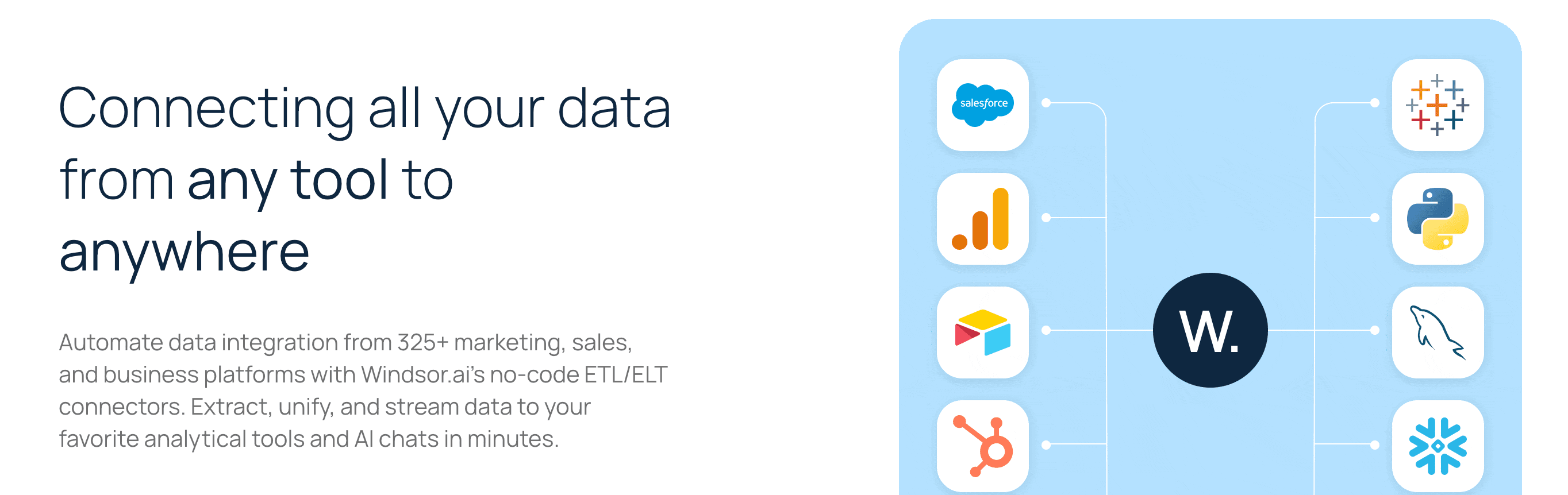
Available as a Google Sheets add-on, Google Data Studio connector, and includes other destinations such as BigQuery, Power BI, etc.
Supported platforms:
Supports 300+ platforms such as Facebook Ads, Amazon Seller Central, FirstPromotor, GA4, Salesforce, etc.
Key features:
- ELT/ETL Pipelines: Build end-to-end pipelines for advanced data processing.
- Automated reporting: Automate cross-platform data integration that handles schema mapping, updates and real-time syncs.
- Windsor MCP: Integrate your Windsor data with the LLM platform and get insights within minutes.
- Customizable templates: Access fully customizable templates across different categories, such as PPC, social media, ecommerce, etc, to deliver personalized reports.
- Wide range of data source integrations and destinations.
- Windsor MCP for AI-driven analysis.
- Unlimited reports for BI destinations.
Admin T
"Windsor.ai makes it incredibly easy to connect data from multiple platforms—Google Ads, Facebook, LinkedIn, HubSpot, and more—into one unified view. The integrations are seamless, the dashboards are clear, and it saves me hours every week"
- If you use data warehouses and databases, you may face limitations on monthly active rows.
- Steep learning curve for non-technical users.
- Customers find issues with the support team in processing refunds.
Verified User in Computer Software
"No refunds, clumpsy interface, bad customer support."
First-Hand Experience
Windsor.ai feels built for teams that care deeply about data accuracy and flexibility. Connecting multiple marketing platforms into a single data flow is smooth, especially when pushing data into BI tools or spreadsheets. Users often highlight how well it handles complex attribution paths and cross-channel analysis without forcing rigid report structures.
In practical use, the strength shows up when working with blended data. Scheduled syncs run reliably, and having control over how metrics are mapped gives analysts more confidence in the numbers they present. This makes Windsor.ai popular among performance-driven teams who need more than surface-level reporting.
That said, it is not the most visual-first tool. The setup requires a bit of technical comfort, and users looking only for ready-made dashboards may find the learning curve slightly higher. The payoff comes when deeper insights matter more than presentation polish.
Overall, Windsor.ai suits teams that want control, accuracy, and scalable data modeling rather than fixed templates.
Pricing and Value
Windsor offers a free plan, which includes 1 user, 1 data source, 1 account and 5M MAR. The paid plans are as follows:
- Basic – $19/month – 3 data sources, 75 accounts, daily refresh, 5 database destination tasks, unlimited users, 5M MAR.
- Standard – $99/month – 7 data sources, 75 accounts, daily/hourly sync, unlimited database destination tasks, 7.5M MAR.
- Plus – $249/month – Includes Standard plan features, 10 data sources, 200 accounts, 10M MAR.
- Professional – $499/month – Includes Plus plan features, 14 data sources, 500 accounts, auto-add all accounts, SSO, daily/hourly/15mins sync.
- Enterprise – Custom – Includes Professional plan features, 300 data sources, 50,000 accounts, enterprise SLA.
A major concern is that the pricing jump from Basic ($19/month) to Standard ($99/month) feels huge. SMBs and marketers might find pricing to be steep, considering scalability.
Final Verdict
Windsor.ai is a strong choice for marketers and analysts who need flexible data pipelines and reliable multi-source reporting. It prioritizes data depth and attribution clarity, which makes it ideal for performance analysis and long-term decision-making.
If your reporting depends on clean data foundations and advanced analysis, Windsor.ai delivers more room to grow.
11. Whatagraph
Supported platforms:
Supports 50+ native integrations across different categories such as PPC, social media, SEO, analytics, email, etc.
Key Features:
- Drag-and-drop editor: Easy-to-use editor with cross-channel widgets and flexible customization options.
- Automated reporting: Share live, real-time updates to clients via Slack, Notion, BigQuery or Google Data Studio.
- AI-powered insights: Whatagraph IQ helps you easily build reports with custom prompts.
- Custom transformations: Create custom metrics, dimensions, source tags and aggregate source blends.
- Excellent customer support.
- Intuitive client reporting interface
- Pre-made templates & data transformations.
Bruhith I
"The dashboards are clean, easy to build, and perfect for client reporting. It pulls in data from Google Ads, Meta, LinkedIn, and even TikTok without any hassle. "
- Widgets can break if multiple people edit the report simultaneously.
- Pricing feels expensive for SMBs.
Muhammad Umar A
"I was not able to fetch the key matrices in the campaign(s), such as purchases, adds to cart, etc. For this, I had to add a custom box, and fill out the entires manually."
First-Hand Experience
Whatagraph is designed for agencies that want reports to look client-ready from day one. Creating dashboards feels intuitive, and the layout editor makes it easy to tell a performance story without heavy setup. Many users appreciate how quickly they can turn raw metrics into polished reports.
In everyday use, automation does most of the heavy lifting. Reports update on schedule, visuals stay consistent, and collaboration features help teams manage multiple clients without confusion. This makes Whatagraph especially useful for agencies handling frequent reporting cycles.
However, flexibility has its limits. Users sometimes mention restrictions when trying to customize metrics beyond standard definitions or when working with highly specific data models. It works best when your reporting needs align with common marketing KPIs.
Overall, Whatagraph prioritizes clarity and presentation over deep analytical customization.
Pricing and Value
Whatagraph offers two pricing plans.
- Max: $1118/month – IQ Agents, Advanced integrations, Data groups, blends, white-label reports, KPI overview with alerts.
- Prime: Custom – IQ Agents, Premium integrations, Custom report domain, Public API access, Transfer to BigQuery or Looker Studio.
Final Verdict
Whatagraph is a strong fit for agencies that want visually impressive reports with minimal effort. It helps teams communicate results clearly and maintain brand consistency across clients without spending hours on formatting.
If your goal is fast, polished reporting that clients immediately understand, Whatagraph offers a more refined experience.
Conclusion
Choosing the right alternative to Reporting Ninja depends on how efficiently your reporting fits into everyday work. As reporting needs grow, teams often start looking beyond basic dashboards toward tools that offer faster data refreshes, smoother workflows, and fewer limitations around integrations or usage. A strong reporting solution should reduce manual effort, scale with campaign complexity, and stay reliable even as data volume increases.
Among the available options, Two Minute Reports stands out for teams that value speed, flexibility, and consistency. With faster data syncs through Speedboost, seamless integrations with Google Sheets and Google Data Studio, and unlimited reporting without restrictive caps, it removes many of the friction points users experience with traditional reporting tools. Dashboards load quickly, automation feels dependable, and setup stays simple even across multiple clients.
Try Two Minute Reports free for 14 days and experience reporting that is built for performance and built for growth.
Frequently Asked Questions
Choose a tool that supports all your required data sources, works with your preferred reporting platform, and scales without slowing down as client volume grows.
Teams switch when they need more integrations, faster report performance, and greater flexibility than Reporting Ninja offers at scale.
Broad connector coverage, automated refreshes, fast report loading, client-ready outputs, and easy multi-account management.
Integration caps, slow performance with large datasets, restricted refresh frequencies, and pricing that increases as reporting needs grow.

Meet the Author
Shabika VenkidachalamShabika, at her core, is a storyteller who believes even data-heavy topics can be infused with heart. At Two Minute Reports, she blends creative writing with user intent to create clear, purposeful content that is deeply human. Away from her desk, she finds inspiration in nature, where creativity flourishes without distractions.


More Alternatives to Explore
See how Two Minute Reports compares to other reporting tools.


Take back your time. Wow clients.
Get Two Minute Reports.
Start your free trial todayBuilt by marketers. Built for marketers.