
Summarize this blog post with:
Reporting is the only bridge between the work you do and the value your client perceives. If you aren't reporting effectively, you aren't proving your worth; you’re just an expense on a balance sheet. Today, a great digital marketing report isn't just a collection of numbers; it is a narrative that explains how those numbers are driving the business forward.
Most marketers fall into the trap of the "Data Dump", sending over massive spreadsheets or 20-page PDFs filled with raw metrics that overwhelm the client. When a client doesn't understand the data, they view marketing as an expense rather than an investment.
However, when you provide a strategic insight, you translate those numbers into a story of success. You show exactly how specific actions, like a PPC adjustment or an SEO update, are solving business problems. This clarity turns data anxiety into client confidence and ensures your agency is seen as an essential partner in their growth.
Key takeaways
- Reporting is a strategic asset, not a chore: The best reports don't just list what happened; they prove your worth by connecting tactical marketing moves to a client's bottom-line revenue.
- Segment your KPIs for clarity: Avoid "Data Overload" by organizing your metrics. CEOs need high-level Strategic KPIs (ROI, CAC), while implementation teams need Tactical & optimization KPIs (CTR, Quality Score) to refine daily performance.
- Establish a "single source of truth": Stop jumping between siloed dashboards. Use an automated reporting tool like Two Minute Reports to aggregate your SEO, PPC, and Social data in one place for accurate, cross-channel attribution.
- Master the hybrid cadence: Maintain a pulse on the "engine" with weekly operational updates, but reserve your big-picture strategy and budget shifts for monthly executive summaries.
- Automate to elevate: Every hour spent on manual data entry is an hour lost on growth strategy. Automating your reporting pipeline allows you to shift from being a "Data Janitor" to an indispensable Strategic Consultant.
What is a Digital Marketing Report?
A digital marketing report is a curated summary of performance data from multiple channels, such as SEO, PPC, and Social Media, measured against specific business objectives. It serves as the truth, 2moving beyond raw numbers to explain the ROI of every dollar spent.
The strategic benefits of digital marketing reports
A report isn't just an archive of the past; it’s a tool for future growth. Its true value lies in:
- Budget Justification: Providing hard evidence that your marketing spend is generating a positive return.
- Client Retention: Building long-term trust by showing a clear, consistent path toward their business goals.
- Trend Identification: Spotting performance shifts early enough to pivot strategy before wasting budget.
- Operational Transparency: Ensuring that all stakeholders, from the CMO to the sales team, understand what is actually moving the needle.
The KPI framework: Strategic vs. operational metrics
To avoid the "Data Dump," you must categorize your metrics based on who is reading them. A CEO cares about revenue; a social media manager cares about engagement. Effective reporting satisfies both by organizing KPIs into levels.
Strategic KPIs (The executive view)
These metrics measure high-level business health and are the primary focus for stakeholders.
- Customer Acquisition Cost (CAC): The total cost to acquire a new customer.
- Return on Ad Spend (ROAS): Revenue generated for every dollar spent on advertising.
- Customer Lifetime Value (CLV): The total revenue a customer brings in over their entire relationship.
Operational & tactical KPIs (The implementation view)
These metrics track the daily health of your campaigns and help you optimize on the fly.
- Optimization KPIs: A/B test results, landing page conversion rates, and Quality Scores.
- Tactical Metrics: Click-through rates (CTR), cost-per-click (CPC), and follower growth.
- Operational Health: Email open rates, website uptime, and engagement rates.
Marketing efforts to highlight in client reports
When building your narrative, don't just report on channels in silos. Highlight the synergy between your efforts to show a holistic strategy.
- Cross-channel impact: Show how your Top-of-Funnel social ads are driving an increase in "Brand" searches on Google.
- Conversion paths: Use attribution data to show the multiple touchpoints it took to close a high-value lead.
- Win/loss analysis: Don't hide the "losses." Highlighting a failed test and explaining the pivot shows more expertise than a report that only shows green arrows.
Automation & efficiency: The reporting solution
Efficiency is the difference between a profitable agency and one that is buried in administrative overhead. Here is how to build a high-performance reporting stack.
Marketing reporting tools and software
Most agencies use a mix of three tool categories to manage their data:
- SEO & PPC platforms (Semrush, Ahrefs, Google Ads): These are your primary sources. They are excellent for deep-dive technical research, but were never designed for client-facing presentation.
- Web Analytics (GA4): This is your conversion source. It tells you what happens after the click.
- Data aggregators: This is the missing link. Tools like Two Minute Reports pull data from all the above sources into a unified environment (like Google Sheets or Looker Studio), allowing you to see how your SEO efforts impact your GA4 revenue in a single table.
Simplify the reporting process with Two Minute Reports
Two Minute Reports is an automated data pipeline that allows you to pull over 30+ marketing integrations, including Facebook Ads, TikTok, Google Ads, and GA4, directly into your existing spreadsheets. By connecting directly to the APIs of these platforms, Two Minute Reports eliminates the need for manual CSV exports and the "copy-paste" errors that haunt manual reporting.
The power user workflow: Instead of logging into five different dashboards every morning, a power user sets up a single "Master Sheet." With Two Minute Reports, you can schedule hourly or daily refreshes so that your data is always live.
Streamline reporting with digital marketing templates
You shouldn't have to reinvent the wheel for every client. The most efficient agencies use specialized templates for different stakeholders:
Stakeholder-Specific Templates
- Monthly Executive Summaries: High-level dashboards for CEOs and CMOs. These focus on bottom-line results like ROI, ROAS, and Lead Volume, cutting out the technical noise to show overall business impact.
- Weekly PPC Snapshots: Tactical reports for Ad Managers. These track "engine room" metrics such as spend pacing, CPC trends, and creative performance to allow for mid-month optimizations.
- SEO Health Check Templates: Detailed views for Marketing Leads. These focus on the long-term compounding value of organic search, including keyword rankings, backlink growth, and technical site health.
Channel-Specific Templates
Ecommerce templates: Designed to track the path from "Visit" to "Value." Key metrics include Average Order Value (AOV), Conversion Rate, and Top-Selling Products.
Shopify Overview ReportView Template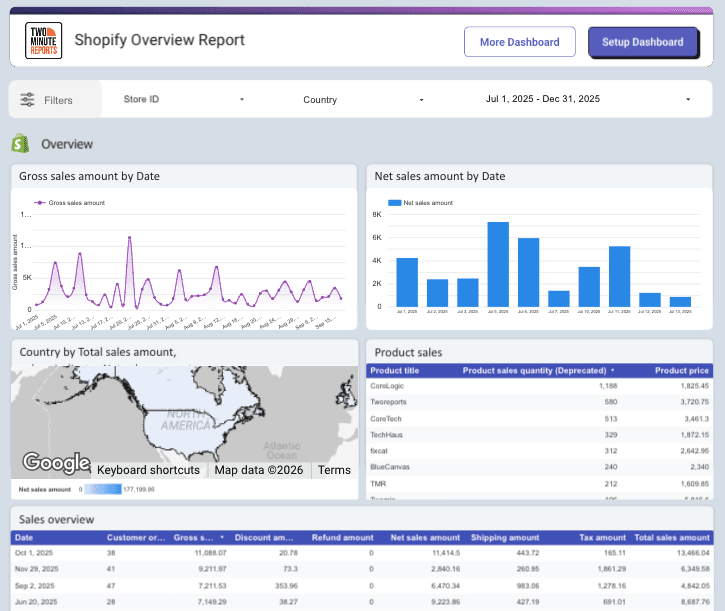
Web analytics templates: These provide a deep dive into user behavior. Track Engagement Rates, Top Landing Pages, and Traffic Sources to see how users interact with your brand.
Google Analytics 4 Overview ReportView Template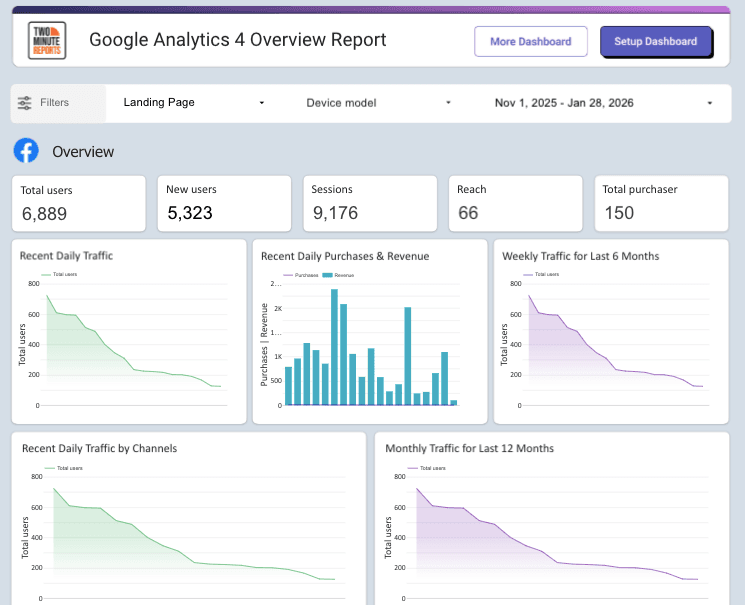
SEO performance templates: Beyond health checks, these track organic growth over time, monitoring Organic Impressions (Search Console) and Share of Voice against competitors.
Google Search Console Overview ReportView Template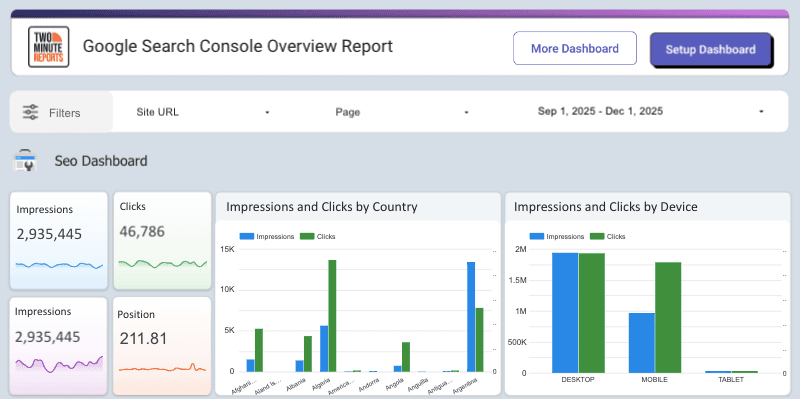
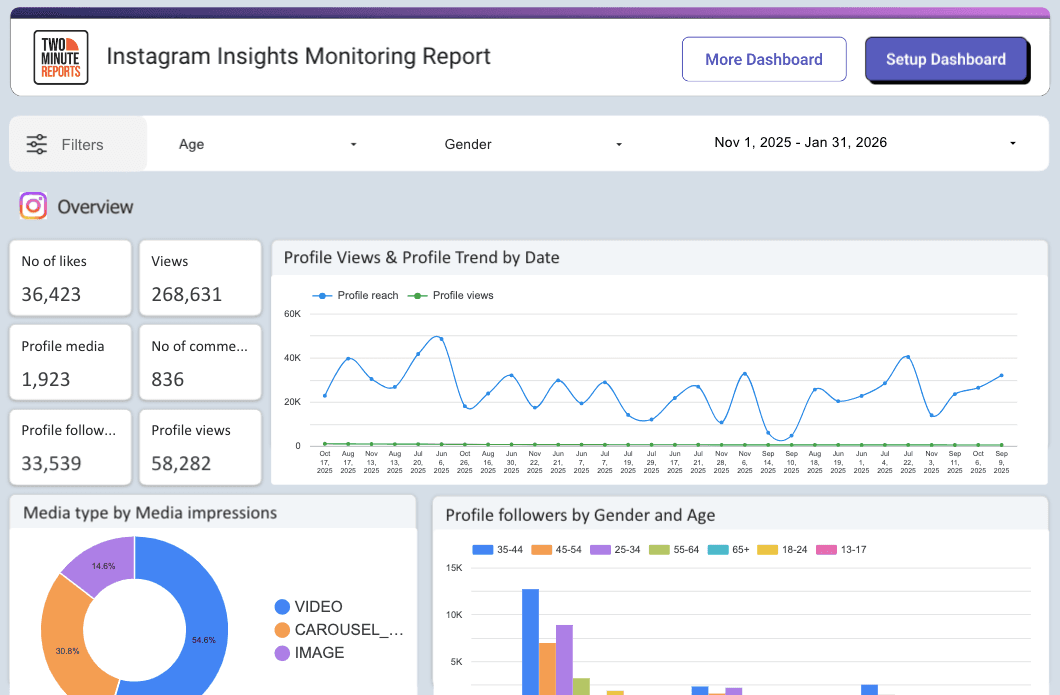
- Social media templates: Bridge the gap between community growth and website traffic by tracking Reach, Engagement Rate per Post, and Social-to-Web referral traffic.
Strategy & cadence: Finding the right rhythm
Data is only useful if it arrives at a time when you can actually act on it. A report delivered too often becomes "noise," while one delivered too late is just a post-mortem of a failed campaign.
What is the ideal frequency for digital marketing reporting?
The ideal frequency for digital marketing reporting is a hybrid model: weekly for operational adjustments and monthly for strategic planning. This cadence ensures that you are catching technical errors in real-time while allowing enough time for high-level trends to emerge before making major budget shifts.
- Weekly (Operational): These reports are the "engine check." They focus on tactical health, spend pacing, ad disapprovals, or sudden dips in CTR. Weekly updates keep clients informed and show that you are actively steering the ship.
- Monthly (Strategic): This is the "navigation chart." Monthly reports ignore the daily "jitter" and focus on long-term growth, ROI, and competitor movement. This is the meeting where you discuss shifting budgets between channels or launching new initiatives.
How to gather data?
Gathering data for digital marketing reports requires moving away from siloed platform dashboards and toward a Single Source of Truth (SSOT), a unified location where all your marketing, sales, and CRM data live together. Without a centralized source, you are forced to manually stitch together conflicting numbers from Google Ads, Meta, and GA4, which leads to "data gaps" and human error.
The "Single Source of Truth" concept isn't just about convenience; it’s about attribution. When your data is unified, you can see the complete customer journey, for example, how a lead who first clicked a LinkedIn ad (Social) eventually converted through a "Brand" search (SEO). Tools that automate this aggregation don't just save time; they provide the clarity needed to see which channels are actually contributing to the bottom line.
The path forward: From building to consulting
The era of the "Report Builder" is over. Nowadays, clients and stakeholders don't value the person who can make a pretty chart; they value the expert who can tell them what the chart means for their business.
The most successful marketers use automated reports to spend 90% of their time on consulting and only 10% on data retrieval. By automating the tedious parts of the process, exporting CSVs, cleaning data, and manual formatting, you reclaim the mental space needed to solve complex business problems.
As you refine your reporting process, remember these three principles:
- Context over Content: Don't just report that "Traffic is up 10%." Explain why it happened and what you will do to make it 20% next month.
- Automate the Routine: Use tools like Two Minute Reports to ensure your dashboards refresh themselves. If a task is repetitive, it should be automated.
- Focus on Impact: Always lead with the metrics that affect the client’s wallet, Revenue, ROAS, and CAC.
A digital marketing report shouldn't be a record of the past; it should be the blueprint for your next win. When you stop "building" and start "consulting," you transform from a vendor into an indispensable strategic partner.
Frequently Asked Questions
ROI (Return on Investment) or ROAS (Return on Ad Spend) are the most important metrics because they directly measure the financial success of a campaign. While engagement and clicks show interest, ROI proves that marketing efforts are generating more revenue than they cost.
Focus only on the 3–5 Key Performance Indicators (KPIs) that align with the client’s primary business goals. Avoid listing every available metric and instead provide a high-level executive summary that explains the "why" behind the numbers rather than just the raw "what."
Data discrepancies occur because each platform uses different attribution models, cookie-tracking settings, and time zones. For example, Google Ads may track a conversion on the day of the last click, while GA4 may record it on the day the conversion actually happened, leading to mismatched totals.
Send high-level strategic reports monthly, but provide access to an automated, live dashboard for weekly or real-time performance tracking. This frequency keeps the client informed without overwhelming them with minor daily fluctuations that don't impact long-term strategy.
Automated reporting software is superior because it eliminates human error and saves hours of manual data entry. Automation allows you to scale your agency by focusing your time on analyzing data and providing strategy rather than simply moving numbers from one sheet to another.
Related Blogs




Meet the Author
Shabika VenkidachalamShabika, at her core, is a storyteller who believes even data-heavy topics can be infused with heart. At Two Minute Reports, she blends creative writing with user intent to create clear, purposeful content that is deeply human. Away from her desk, she finds inspiration in nature, where creativity flourishes without distractions.