Summarize this blog post with:
Search engine rankings rarely fail all at once. They slip quietly. One keyword drops three positions. Another disappears from page one. Traffic looks mostly fine until a client asks why leads slowed down.
By then, you’re already behind. Manual rank tracking means checking positions after the damage is done, pulling data into spreadsheets, and trying to spot patterns in disconnected snapshots.
Automated search engine ranking reports solve this by monitoring positions continuously and surfacing what matters – which keywords moved, where competitor gaps opened, and how ranking shifts correlate with actual traffic and conversion changes. Instead of reacting to problems, you spot them proactively and act quickly on changes.
In this guide, we’ll break down the significance of search engine ranking reports, what they must include to be actionable, and how modern SEO reporting platforms such as Two Minute Reports help you translate and automate raw SERP movement into clear, decision-ready insights.
What Are Search Engine Ranking Reports?
A search engine ranking report is a structured system for tracking how your website’s pages rank for target keywords across search engines over time. While a single keyword rank shows where you stand today, a ranking report reveals patterns, momentum, and potential risks in your SEO performance.
Instead of relying on isolated snapshots, ranking reports help marketers understand whether their visibility is improving, declining, or fluctuating across the SERP. Here’s how it helps:
Tracking Keyword Performance Over Time
Search rankings are dynamic. Keywords move daily due to competition, algorithm updates, and content changes. A ranking report captures these shifts and highlights trends that would otherwise go unnoticed.
For example, a page steadily climbing from position 18 to 9 signals growth potential, while a sudden drop from position 3 to 12 may indicate technical or competitive issues.
Beyond Manual Checks and Static Lists
Traditionally, marketers tracked rankings by manually searching keywords and recording results. This approach is no longer reliable because:
- Search results vary by location, device, and personalization.
- Manual tracking becomes outdated almost instantly.
- SERP features like featured snippets, AI answers, and local packs are often missed.
Automated search engine ranking reports solve these limitations by providing consistent, real-time visibility into SERP performance, without relying on outdated spreadsheets.
Understanding Visibility, Not Just Rankings
Modern ranking reports go beyond positions and introduce metrics like visibility score or share of voice. These metrics weigh rankings based on search volume and intent, enabling marketers to understand the actual impact of their SEO efforts.
A well-built SEO ranking report lets you monitor these insights clearly, allowing teams to prioritize actions that optimize traffic, conversions, and revenue.
Why Ranking Reports Matter for SEO Performance?
Search engine rankings are more than vanity metrics. They act as real-time signals that reveal how your SEO strategy is performing long before traffic or conversions change.
With consistent SEO tracking, ranking reports help marketers move from reactive fixes to proactive optimization.
Ranking Shifts as Early Warning Signals
In most cases, ranking changes happen before traffic drops.
If a high-performing keyword slips from position 2 to 7, it is often the first sign of declining visibility. Without a ranking report, this shift might go unnoticed until organic traffic and leads start falling.
Automated ranking reports help teams detect these movements early, giving them time to optimize content, improve technical SEO, or strengthen internal linking before performance is affected.
Explaining the Impact of Algorithm Updates
Search engines constantly update their algorithms, and even minor changes can reshape the SERP.
Ranking reports make it easier to understand:
- Which keywords gained or lost visibility?
- Whether specific pages or content types were affected?
- If changes were isolated or site-wide?
Instead of guessing why performance changed, marketers can rely on ranking data to identify patterns and make informed adjustments.
Prioritizing SEO Actions That Actually Matter
Not every SEO task delivers the same impact.
Ranking reports help identify high-opportunity keywords and pages, such as:
- Keywords stuck just outside page one (positions 8–15)
- Pages that are losing visibility despite strong traffic potential
- Topics where competitors are gaining ground
By highlighting these opportunities, ranking reports help teams focus on actions that deliver the highest ROI, rather than spreading effort across low-impact tasks.
Core Metrics Every Search Engine Ranking Report Should Include
A search engine ranking report is only as useful as the SEO metrics it tracks. Simply listing keyword positions is not enough. Modern SEO teams need a mix of ranking, visibility, and movement metrics to understand the SERP performance.
Below are the essential metrics that turn raw ranking data into actionable insights.
Keyword Ranking Position
The most fundamental metric in any ranking report is keyword position.
This shows where your website appears in search results for target keywords at a given point in time. But the real value comes from tracking position changes over time rather than looking at isolated ranks.
A strong ranking report highlights:
- Current keyword positions.
- Historical trends and fluctuations.
- Sudden drops or spikes that signal potential issues or opportunities.
Instead of asking, “What is our rank today?”, marketers should ask, “How is our ranking evolving?”
Ranking Distribution Across SERP Positions
Individual keyword ranks don’t tell the full story. Ranking distribution shows how your keywords are spread across the SERP.
Typical distribution buckets include:
- Positions 1-3 (high visibility, capturing 75% of clicks)
- Positions 4-10 (rest of page 1, capturing 25% of clicks)
- Positions 11-20 (page 2, capturing 3% of clicks)
- Positions 21+ (page 3 and beyond, minimal traffic)
This metric helps you understand whether your SEO strategy is building real visibility or just generating scattered rankings with limited impact.
For example, keywords ranking on page 2 (positions 11-20) often represent quick-win opportunities. With targeted optimization, they can be pushed to page 1 without starting from scratch.
Search Visibility Score
Search visibility score measures how visible your brand is in search results, weighted by keyword volume and ranking position.
Unlike average rank, the visibility score reflects estimated traffic potential based on search volume and position – though the actual traffic depends on CTR, which varies by intent, and SERP features.
A rising visibility score indicates that your site is gaining meaningful exposure in search results, particularly for high-volume keywords, even if average keyword rankings appear stable. This makes it one of the most reliable indicators of long-term SEO growth.
SERP Feature Presence
Modern SERPs are no longer just blue links. Ranking reports should track whether your site appears in key SERP features, such as:
- Featured snippets
- Local or map packs
- People Also Ask boxes
- Image or video results
- AI-Overviews (Google’s generative AI results)
Monitoring SERP feature presence helps marketers understand how search behavior is shifting and where visibility opportunities exist beyond traditional rankings.
Keyword Movement Trends
Keyword movement trends show how many keywords have improved, declined, or remained stable over a specific period.
This metric provides a high-level view of SEO momentum and helps answer questions like:
- Are we gaining or losing overall visibility?
- Are ranking improvements consistent or isolated?
- Are competitors overtaking key positions?
Instead of reacting to individual keyword drops, movement trends help teams evaluate the broader direction of their SEO performance and identify whether the changes are a part of a larger pattern or temporary fluctuations.
Search Engine Ranking Reporting Tools Overview
A good search engine ranking tool should reduce manual effort while increasing the depth and reliability of SEO insights.
What to Look for in a Ranking Reporting Tool?
Not all ranking tools are built for scalable SEO reporting. Before selecting a tool, marketers should evaluate whether it supports automation, customization, and multi-dimensional tracking.
Automated Data Updates
The most critical feature of a ranking reporting tool is automatic data refresh.
Instead of manual exports, the tool should:
- Track keyword rankings continuously.
- Update data on a fixed schedule (daily, weekly, or monthly).
- Maintain consistent tracking across devices and locations.
Automation ensures that ranking insights are always current and reliable.
Customizable Dashboards
SEO teams rarely rely on a single metric. A strong ranking tool should allow users to build dashboards tailored to their goals.
Custom SEO dashboards help marketers to:
- Focus on business-relevant metrics instead of raw rankings.
- Combine keyword data with traffic, conversions, and revenue.
- Present insights in a format suitable for stakeholders.
Flexibility in SEO reporting is essential for agencies, in-house teams, and multi-client workflows.
Scheduled Report Delivery
Manual reporting slows down decision-making.
Modern ranking tools enable scheduled report delivery, allowing teams to automatically share updates with clients, managers, or stakeholders.
This feature helps maintain consistent communication while eliminating repetitive reporting tasks.
SERP Feature and Visibility Tracking
Traditional rank tracking is no longer enough.
Advanced tools should detect SERP features such as:
- Featured snippets
- Local packs
- People Also Ask sections
- Video and image results
- AI-generated overviews
Tracking these elements provides a more accurate picture of search visibility beyond blue-link rankings.
Top Tools for Automated Ranking Reports
Below are some of the most reliable tools marketers use to generate automated search engine ranking reports.
Two Minute Reports
Best for: Automated SEO dashboards and reporting workflows
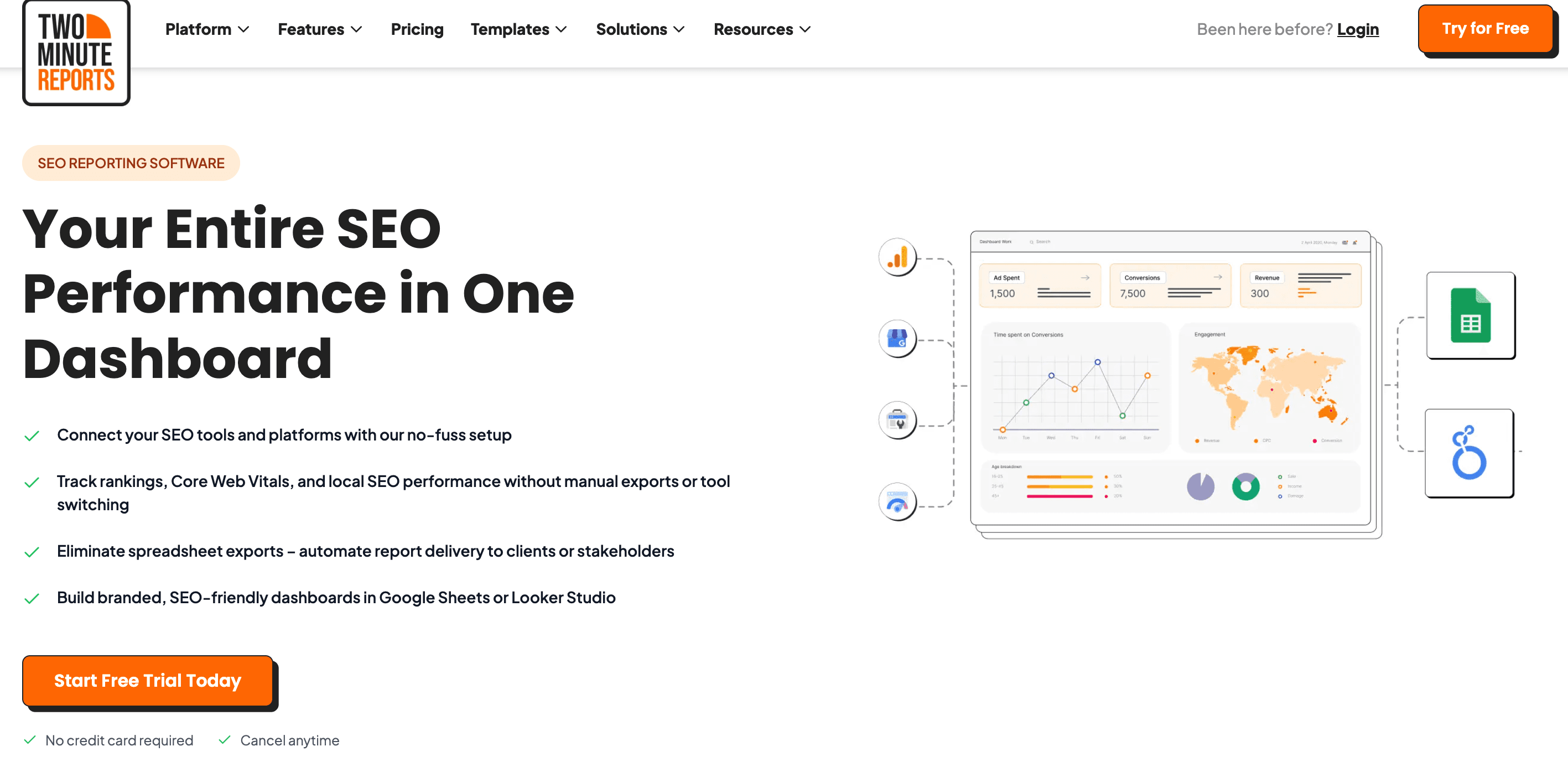
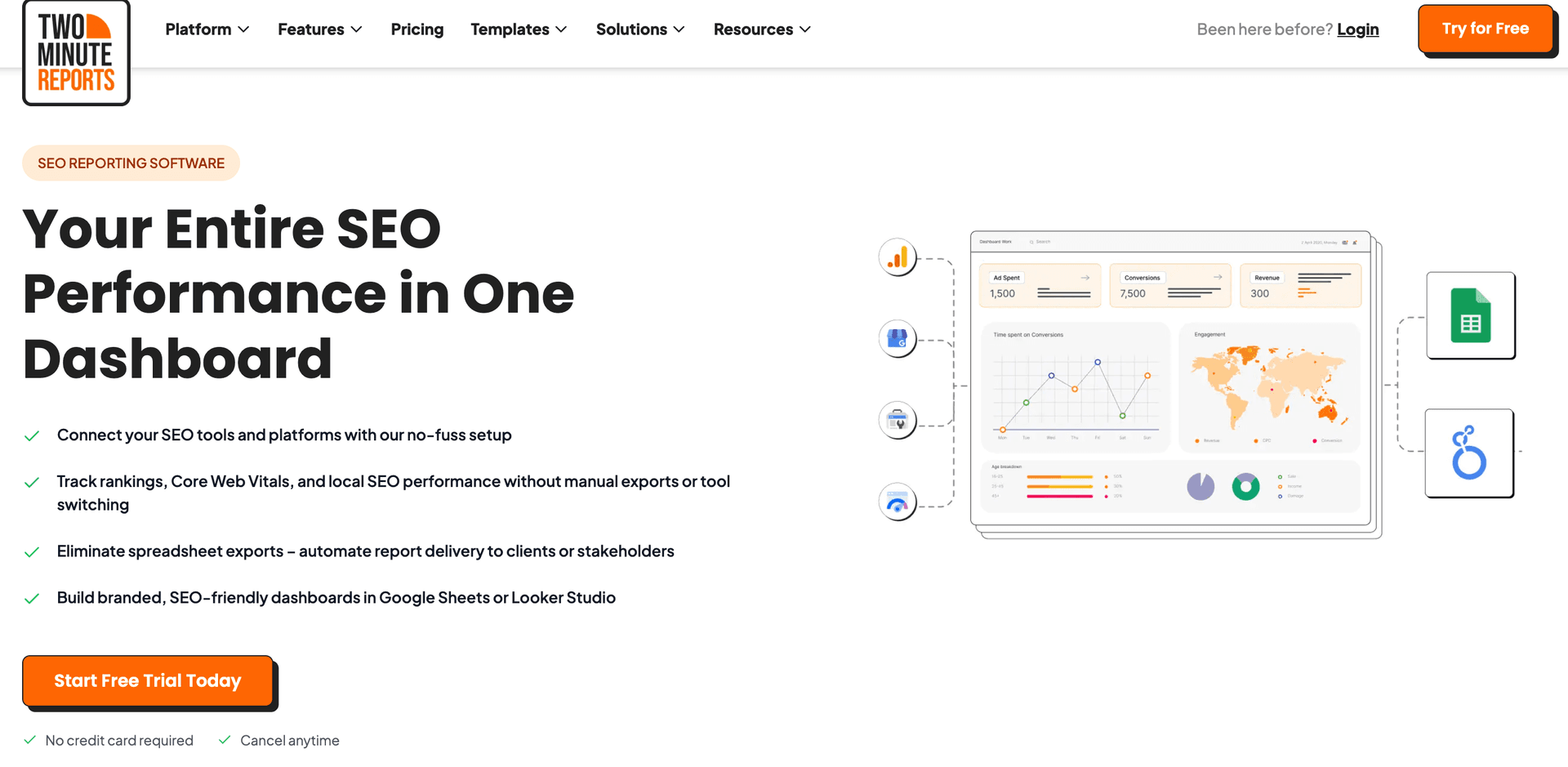
Two Minute Reports simplifies search engine rank tracking by automatically pulling ranking-related data from platforms like Google Search Console, Google Analytics, Google Business Profile, etc., making it a powerful SEO reporting software for teams using Google Sheets and Google Data Studio.
All you need to do is connect your SEO platforms (GSC, GMB, etc), choose the client accounts and metrics you need, and generate optimized SEO ranking reports in minutes – no technical setup required.
Key strengths:
- Automated syncing of ranking and performance metrics.
- Customizable SEO dashboards tailored to business goals.
- Add, update, or remove multiple client accounts in one place.
- Scheduled report delivery to teams and stakeholders.
- Create unlimited SEO reports across multiple clients to scale performance.
Why it matters: Two Minute Reports helps bridge the gap between raw ranking data and decision-ready insights, making it easier for teams to track SEO performance without manual effort.
SEMrush
Best for: Comprehensive keyword tracking and competitive analysis
SEMrush is one of the most widely used SEO platforms for monitoring keyword rankings and analyzing SERP dynamics.
Beyond rank tracking, it provides deep insights into competitor performance, keyword opportunities, and SERP feature visibility.
Key strengths:
- Daily keyword rank tracking across multiple regions.
- SERP feature monitoring (featured snippets, local packs, etc.).
- Competitor keyword and domain analysis.
- Long-term ranking history and trend analysis.
Why it matters: SEMrush helps marketers understand not only where they rank, but also how competitors are gaining or losing visibility across the SERP.
Ahrefs


Best for: Accurate ranking data and organic search insights
Ahrefs combines rank tracking with backlink analysis and content performance data, offering a holistic view of SEO performance.
Its strength lies in connecting keyword rankings with broader SEO factors such as links and content quality.
Key strengths:
- Historical keyword ranking data.
- Location-based SERP tracking.
- Organic traffic and keyword potential estimation.
- Correlation between rankings, content, and backlinks.
Why it matters: Ahrefs enables marketers to interpret ranking changes in the context of SEO actions, such as content updates or link-building campaigns.
SE Ranking


Best for: Cost-effective rank tracking
SE Ranking is a flexible rank tracking tool that balances affordability with automation features, making it popular among small teams and growing businesses.
It offers essential rank tracking capabilities without the complexity of enterprise SEO platforms.
Key strengths:
- Daily keyword tracking and SERP snapshots.
- Local and mobile ranking analysis.
- Automated report scheduling.
- Scalable keyword tracking options.
Why it matters: SE Ranking is ideal for teams that need reliable automated ranking reports without investing in complex, high-cost platforms.
Best Practices for Effective SEO Rank Reporting
The best reports are designed to communicate insights, guide decisions, and align with business goals. Here are the key best practices:
- Customize reports for the audience: Tailor the report format and metrics based on who is reading it. Executives need high-level insights, while SEO teams require detailed keyword and SERP data.
- Track trends over time, not isolated rankings: Focus on long-term ranking patterns instead of one-time snapshots. Trend analysis reveals whether SEO performance is improving, declining, or stabilizing.
- Add context, not just numbers: Explain why rankings changed by linking data to algorithm updates, content changes, technical fixes, or competitor activity.
- Combine ranking data with performance metrics: Pair keyword positions with CTR, organic traffic, and conversions to understand the real business impact of ranking changes.
- Automate reporting cadence: Automate SEO reports on a consistent schedule, ensuring you deliver timely performance insights to your clients.
Common Ranking Reporting Mistakes to Avoid
Even with advanced tools and automation, ranking reports can become misleading if they are not interpreted correctly. Avoiding these common mistakes helps ensure that ranking data leads to accurate insights and better SEO decisions.
Get Real-time Ranking Reports and Win Clients’ Trust
Search engine ranking reports create value only when it leads to action. With dynamically changing SERPs, relying on manual checks or static reports makes it harder to spot issues early and explain performance.
With Two Minute Reports, you can translate your ranking data into clear decisions by:
- Automatically pulling key SEO metrics from Google Search Console, Google Analytics, Google Business Profile, Google Trends, etc.
- Centralizing keyword trends, traffic, and conversions in Google Sheets and Google Data Studio.
- Scale multi-client SEO reporting without switching tabs or dashboards.
- Deliver branded, professional SEO dashboards without needing a premium upgrade.
- Get proactive alerts to ensure every scheduled report is complete and error-free.
The next step is simple – set up an automated rank reporting workflow using Two Minute Reports. Try it free for 14 days and see how it helps you act faster with precision.
Frequently Asked Questions
Weekly reports are ideal for most sites, while daily tracking works best for competitive niches or active SEO campaigns.
Yes. SERP features affect visibility and clicks, so tracking them is essential to understand true search performance.
No. Automation provides data, but a human strategy is needed to interpret insights and drive SEO decisions.
SMBs benefit from simple, cost-effective, and agency-focused rank tracking tools such as Two Minute Reports, while enterprises need advanced platforms with large-scale analytics and automation.
Related Blogs





Meet the Author
Shabika VenkidachalamShabika, at her core, is a storyteller who believes even data-heavy topics can be infused with heart. At Two Minute Reports, she blends creative writing with user intent to create clear, purposeful content that is deeply human. Away from her desk, she finds inspiration in nature, where creativity flourishes without distractions.