
Summarize this blog post with:
If you’ve spent any time in a marketing role lately, you’ve likely felt ‘data anxiety’. It’s that nagging feeling on a Friday evening when you have twenty tabs open: Google Search Console, GA4, a few mystery spreadsheets, and three different rank trackers, and you still stumble to answer the simple question: "Is our SEO actually making us money?"
Most businesses treat SEO tracking like a digital receipt. They review it once a month to see what they've spent and where they've landed. However, in 2026, search is no longer a static list of ten blue links. Between AI Overviews, localized Map Packs, and shifting algorithm tides, the "old way" of tracking is the fastest way to become irrelevant.
Key Takeaways
- Scaling SEO tracking requires a shift from monitoring individual keyword rankings to analyzing data clusters and search visibility to maintain a clear view of performance across thousands of pages.
- Local SEO tracking must prioritize geographic-specific data and Google Business Profile metrics to capture how physical proximity influences search intent and conversion rates.
- Enterprise-level performance hinges on the integration of automated reporting and BI tools, allowing teams to synthesize massive datasets into actionable insights without manual overhead.
- Cross-functional alignment between SEO, web development, and data science teams is essential for implementing technical site architecture changes that support large-scale crawlability and indexing.
- A unified measurement framework is critical for connecting organic search efforts to bottom-line business KPIs, ensuring that SEO performance is validated through revenue and ROI rather than just traffic volume.
- Competitive benchmarking at scale allows organizations to identify market share shifts in real-time, providing a defensive and offensive strategy against both local niche players and global competitors.
What is SEO tracking?
At its core, SEO tracking is the continuous process of measuring your website’s performance across search engines to understand what’s driving growth and what’s falling flat.
However, here is the reality check: it’s no longer just about where you "rank" for a single word. Modern SEO tracking is a multi-dimensional view of your search performance. It’s about monitoring how often you appear (Visibility), how many people click (Engagement), and what they do after they arrive (Conversion). If you aren't measuring all three, you’re only seeing a third of the movie.
The "Why": Expense vs. investment
The difference between SEO as an expense and SEO as an investment comes down to how you track it.
- SEO as an Expense: You’re paying for content and backlinks, hoping the "total organic sessions" line in your dashboard goes up. You're guessing.
- SEO as an Investment: You are tracking specific keyword clusters to revenue. You know exactly which blog post led to a demo call and which technical fix boosted your CTR by 2%.
Tracking isn't just about proving you worked; it’s about uncovering the roadmap for what to do next. When you move from "collecting data" to "connecting data," you stop reacting to numbers and start being a growth strategist
5 essential SEO metrics your agency should track
If you want to move the needle for your clients (or your own brand), stop obsessing over vanity metrics and start monitoring these five pillars:
- Organic Share of Voice (SoV): Instead of focusing on individual ranks, consider the broader perspective. Of all the possible clicks for your target keywords, how many are coming to you versus your competitors?
- Non-Branded Keyword Growth: Anyone can rank for their own name. Real growth occurs when you capture users who are searching for a solution but haven't yet heard of your brand.
- Core Web Vitals & Technical Health: Google doesn't just care about what you say; it cares about how your site behaves. Tracking "Largest Contentful Paint" (LCP) and "Cumulative Layout Shift" (CLS) is now a prerequisite for staying on Page 1.
- Conversion Rate by Landing Page: Not all traffic is equally created. A blog post bringing in 10,000 visitors who buy nothing is less valuable than a guide bringing in 500 visitors who convert at 10%.
- Backlink trends: It’s not just about how many links you have, but how consistently you’re earning them compared to your competition. A sudden drop in velocity is often a leading indicator of a future ranking dip.
Why is traditional rank tracking broken?
Traditional rank tracking fails today because search results are no longer static or universal; they are now dynamic, personalized, and often "zero-click." While old-school tracking focuses on a single numerical position, modern SEO performance is defined by SERP presence (AI Overviews, snippets) and topical authority across keyword clusters.
The rise of zero-click searches & AI overviews
We’ve all done it: You search for "How to calculate ROAS," read the AI Overview or the Featured Snippet at the top of the page, get your answer, and leave. You never clicked a single link.
This is the era of the Zero-Click Search. AI answers, “People Also Ask” boxes, and video carousels take up most of the space at the top of Google. So even if you rank high, people might never actually see your link. Success is shifting from position to presence. If your tracking isn't accounting for how often you appear in these "SERP features," you’re missing a significant part of the modern search experience.
The personalization problem: Why "your rank" isn't "their rank."
The idea of a "universal" search result is dead. What you see when you check your rankings from a laptop in a coffee shop in New York is completely different from what a customer sees on an iPhone in London.
Google now tailors results based on:
- Precise location: Especially for "near me" or service-based queries.
- Device type: Mobile vs. Desktop layouts vary wildly.
- Search history: Google learns what a user prefers and adjusts the results accordingly.
Relying on a single "rank" number is like trying to hit a moving target with a blindfold on. Your tracking needs to account for these variables to give you a true average of your actual performance.
Moving from single keywords to topical clusters
In the early days of SEO, we tracked individual keywords like "Blue Running Shoes." Today, Google understands entities and intent. This has led to the rise of "Ranch-style SEO", the idea that you should own an entire topic, not just a phrase.
Instead of obsessing over one high-volume keyword, smart marketers track Topical Clusters. If you track 30–50 semantically related keywords (e.g., best running shoes, marathon footwear, arch support sneakers), you get a much clearer "performance signal." If 40 of those 50 keywords are trending upward, you have topical authority. If only one is up, you have a fluke.
Specialized SEO tracking: Beyond the basics
General tracking is a great start, but as your business model evolves, your metrics must become more granular. Niche authority is built by tracking the specific signals that search engines use to categorize your content.
Tracking local SEO performance
To track Local SEO effectively, you must monitor Map Pack rankings, Google Business Profile (GBP) interactions, and "near me" query visibility across specific geographic coordinates. Unlike standard organic search, local success is measured by how well you dominate the "Local Pack", the top three business listings that appear alongside a map.
Beyond the standard blue links, your "money metrics" here are direction requests, click-to-calls, and review velocity. If you’re a service-based business, ranking #1 in a nationwide search is a vanity metric; you need to be the first thing a customer sees when they’re standing three blocks away with a smartphone. Tracking this requires a localized approach that accounts for the proximity and real-world search behaviour, ensuring you are visible in the exact neighborhoods where your customers live and work.
The global view: Key aspects of international SEO tracking
International SEO tracking involves monitoring performance by country-code top-level domains (ccTLDs), verifying the health of hreflang clusters, and measuring visibility across regional search engines like Baidu or Yandex. It is the process of ensuring that search engines serve the correct language and regional version of your site to the right audience.
When you go global, the complexity of your data multiplies. You’re no longer just tracking keywords; you’re managing currency-based conversion tracking and ensuring your technical setup isn't "cross-wiring" your traffic. Nothing hurts a global expansion faster than a customer in London landing on a page with US dollar pricing, or a lead in Madrid getting stuck in a Mexican-Spanish translation loop. International tracking provides the bird's-eye view needed to maintain brand consistency across every border.
Rank tracking for enterprise SEO
Enterprise SEO tracking focuses on data aggregation across tens of thousands of keywords, automated anomaly detection, and Share of Voice (SoV) metrics across multiple subdomains. At this scale, the priority shifts from monitoring individual keyword shifts to protecting massive, diversified organic revenue streams.
Managing SEO for an enterprise site with 10,000+ pages is a battle against signal vs. noise. You cannot afford to look at every single keyword every day; you would lose sight of the strategy. Instead, enterprise tracking relies on "Topical Clusters" and automated alerts that flag when an entire product category or subdomain experiences a dip. It’s about high-level visibility that allows you to spot a competitor's move across an entire vertical before it impacts your bottom line.
Video SEO rank tracking
Video SEO tracking measures your content's visibility within YouTube search results, Google’s dedicated "Video" tab, and video carousels on the main SERP. This includes monitoring "Key Moments" (the timestamped chapters Google highlights) and "Suggested Video" appearances that drive discovery.
We live in a scroll-first world where a 60-second video can often answer a "How-to" query more effectively than a 2,000-word article. If you are investing in video but only tracking your YouTube views, you are missing half the picture. By tracking how your videos perform on the main Google search page, you capture high-intent users who prefer visual answers, allowing you to dominate the most engaging real estate on the web.
Tools and strategies for effective SEO tracking
Tracking is only as good as the data you can access and, more importantly, how easily you can interpret that data. Here is how to navigate the current landscape of tools.
How to track SEO performance for free through the Google Suite
Google Search Console (GSC) and Google Analytics 4 (GA4) are the primary free tools for tracking organic performance, offering direct data on search visibility, click-through rates, and on-site user behavior. GSC provides the pre-click data (what people searched for to find you), while GA4 provides the post-click data (what they did once they arrived).
While these tools are powerful, they are designed for individual site analysis. For most users, the friction starts when you try to compare the two. You’ll find yourself jumping between tabs to see if the "Impressions" in GSC are actually turning into "Key Events" in GA4. It works for a single project, but once you manage multiple clients or deep keyword clusters, the free method begins to cost you significant time in manual data stitching.
Explore Templates to Track SEO Performance through Google Suite
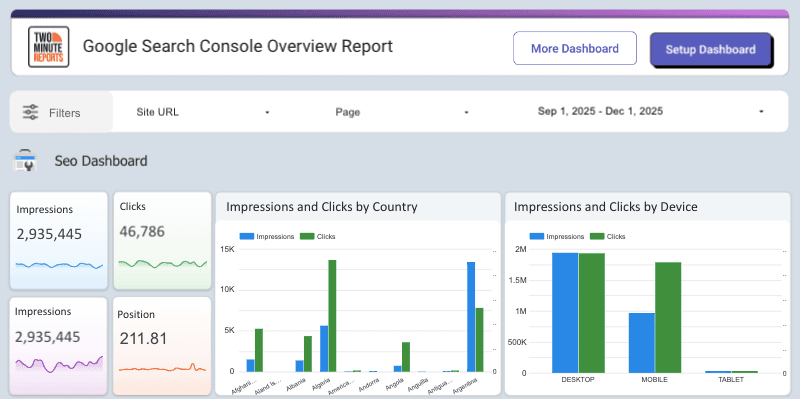
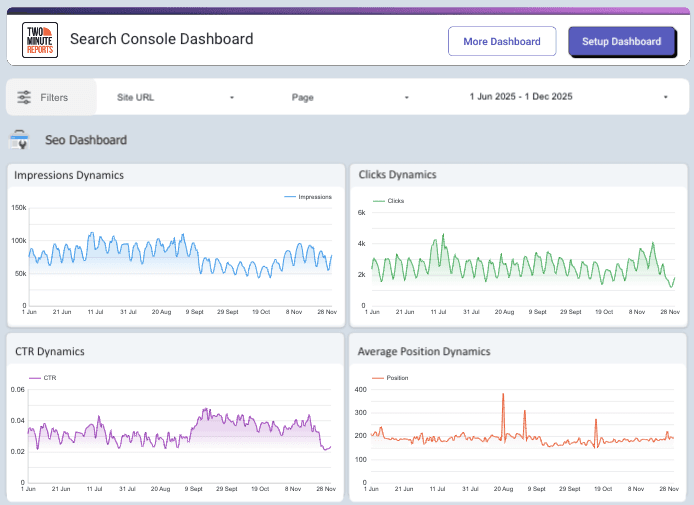
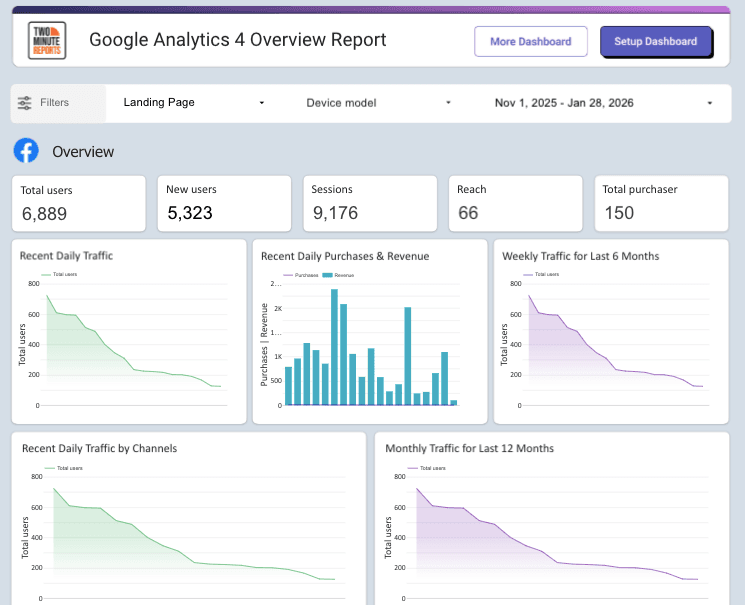
To bridge the gap between "free but manual" and "automated and scalable," you can use Two Minute Reports’ free templates to consolidate your Google Suite data. Instead of manually exporting CSVs, you can use pre-built templates that stitch SEO performance data together in one place.
Google Search Console Overview Report Template
Google Search Console Dashboard Template
Google Analytics 4 Overview Report
The best SEO tracking and reporting tools in the industry
The leading SEO tracking platforms include Semrush, Ahrefs, and Moz, which provide essential third-party data on keyword rankings, backlink profiles, and competitive gap analysis. These tools are the industry standard for off-site tracking, helping you see where you stand in the broader market beyond your own analytics.
Choosing the best tool usually comes down to your specific workflow. If you’re focused on technical audits and backlink health, Ahrefs is a powerhouse. If you’re more focused on content marketing and daily rank tracking across thousands of keywords, Semrush often takes the lead. And, mostly, the data they show is irrelevant. However, the most successful SEOs don't just pick one tool; they find a way to pull the best data from all of them into a single view.
Mastering the agency workflow with Two Minute Reports
For agencies, the biggest hurdle isn't just getting results; it’s the sheer volume of hours required to prove those results to every client. This is where automation moves from a nice-to-have to a business-critical asset.
Performance tracking for SEO agencies: How to use Two Minute Reports for client reporting
Two Minute Reports is an automated reporting tool that pulls live metrics from Google Search Console, GA4, and 30+ other sources directly into Google Sheets or Google Data Studio. It effectively eliminates the need for manual data exports, allowing agencies to build a "Single Source of Truth" where SEO visibility and conversion data live side-by-side.
The agency pain point: We’ve all been there, the "First Week of the Month" mess. You spend 20+ hours trapped in a cycle of logging into different portals, downloading CSVs, and manually building slides. By the time the report is ready, the data is already old, and your team is too exhausted to actually analyze it.
The Two Minute Report fix: Instead of you chasing data, we let the data come to you. With Two Minute Reports, you can pull your GSC keyword positions, GA4 sessions, and even Meta/Google Ad spend of multiple clients into one holistic dashboard.
When a client asks, "How is our organic spend impacting our bottom line?" you don't have to go digging. You simply open your live dashboard and show them the real-time intersection of traffic and revenue.
Tracking isn't about looking back; it's about seeing the path forward.
At the end of the day, we don't track metrics just to see what happened yesterday. We track them to predict what will happen tomorrow. Data is the only thing that removes the "guesswork" from marketing, turning a gut feeling into a scalable roadmap for growth.
When you bridge the gap between complex data sources and simple, automated reporting, you do more than just save time. You gain the clarity needed to pivot when an algorithm shifts and the confidence to show your clients exactly how much their investment is worth.
Frequently Asked Questions
Organic Conversion Rate is the most critical metric because it measures how much organic traffic actually turns into revenue. While rankings show visibility, conversions prove that your SEO strategy is driving business growth and ROI.
Google Search Console shows a "weighted average" position across all users, whereas your live search is a single snapshot influenced by your specific location and device. GSC data is more accurate for long-term strategy because it accounts for thousands of different user sessions.
You should monitor high-level trends weekly and perform deep-dive analysis monthly. Daily shifts are often just "algorithmic noise," but weekly monitoring helps you spot significant technical issues before they impact your bottom line.
Yes, Google Search Console and Google Analytics 4 provide the most accurate first-party data for free. However, while the data is free, the manual labor of merging these sources into a single report often becomes a hidden cost for growing agencies.
Calculate SEO ROI by subtracting your total SEO spend from your organic revenue, then dividing by your total SEO spend. For accurate results, you must use a tool like Two Minute Reports to merge your cost data with your GA4 revenue data automatically.
Related Blogs





Meet the Author
Shabika VenkidachalamShabika, at her core, is a storyteller who believes even data-heavy topics can be infused with heart. At Two Minute Reports, she blends creative writing with user intent to create clear, purposeful content that is deeply human. Away from her desk, she finds inspiration in nature, where creativity flourishes without distractions.