
Summarize this page with:
Let’s be real: Facebook advertising in 2026 isn't the same as it was a few years ago. While the platform remains a powerhouse, with the number of advertisers more than doubling recently, it’s also gotten a lot more crowded.
If you’re among the millions of brands navigating this landscape, you’ve likely felt that familiar sting of metric overload. Between Advantage+ updates, shifting privacy rules, and rising competition, it’s hard to know if your $1.10 CPC is a victory or a cry for help.
Henceforth, we’ve analyzed the latest data shifts to show you exactly where the goalposts have moved. Comparing your campaigns to industry standards isn't about vanity; it's about protecting your budget. By the end of this blog, you’ll know:
- Whether your creative is actually scroll-stopping (via CTR)
- If you're overpaying for someone’s attention (via CPC)
- How efficiently you’re turning strangers into customers (via CVR and CPA)
To give you the most human and realistic view, we didn't just look at the giants with million-dollar budgets. We pulled the median values from a massive dataset of over 1,000+ advertisers.
Why median? It’s because one or two lucky viral ads can skew averages. Whereas Median values represent the middle of the pack, the realistic performance most successful businesses are actually seeing day-to-day.
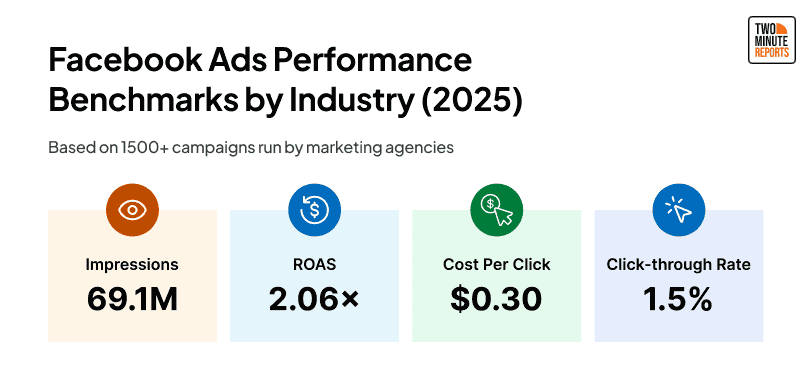
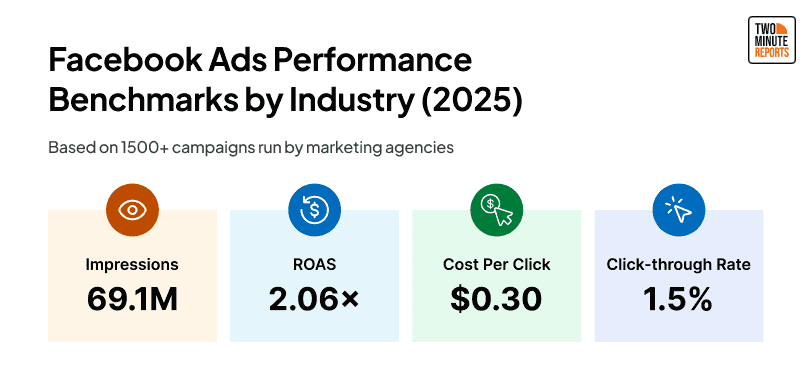 2025 Benchmark Sneak Peek
Key Market Shifts Reshaping Facebook Ads Performance in 2025
If you feel like your ads are working harder just to stay in the same place, you’re not imagining it. 2025 has brought a perfect storm of changes to the Meta ecosystem. To beat the benchmarks, you first have to understand the forces pushing against them.
1. The Lead Gen Tax (Rising Costs)
The most jarring shift this year is the divergence in costs. While Traffic ads have actually become slightly more efficient, Lead Generation costs have spiked. The average Cost per Lead (CPL) jumped roughly 21% year-over-year.
The takeaway: Awareness is cheap; actual intent is getting expensive.
2. Creative Saturation & The 3-Second Rule.
With 85% of DTC brands now using AI to generate creatives, the feed is more crowded than ever. This has led to creative saturation. In 2025, a good ad doesn't just look professional but also authentic.
- Data shows that User-Generated Content (UGC) currently outperforms polished studio ads, with 4x higher CTRs.
- If your creative doesn’t stop the scroll in the first 3 seconds, the algorithm deprioritizes you almost instantly.
3. The Advantage+ (Black Box)
Meta has gone "all-in" on automation. Advantage+ Shopping and Lead campaigns are now the default.
- The pro: It’s a significant time-saver and often surfaces buyer segments you wouldn’t identify through manual targeting.
- The con: It can be volatile. Since you’re giving the AI more control, you might see performance swings where one day is golden, and the next is a ghost town.
4. The Privacy Wall (Attribution Windows)
We are now firmly in a privacy-first world. With the total phase-out of third-party cookies and tighter iOS restrictions, the ‘7-day click, 1-day’ view window is the absolute limit for most.
The shift: Many marketers are moving toward Conversions API (CAPI) to send server-side data back to Facebook, bypassing browser blocks to keep their data clean.
5. Small Business Surge
Finally, the neighborhood is getting noisier. We’ve seen a massive influx of SME (Small to Medium Enterprise) and DTC brands entering the auction. This increased competition for the same audience segments is the primary driver behind CPM inflation.
Why do marketers and agencies need Facebook Ads Benchmarks?
If you're running ads without benchmarks, you're essentially flying a plane without a dashboard. You might be moving, but you have no idea if you’re about to crash or if you're soaring above the competition.
1. Turning Data into a Strategy (The Agency Edge)
Agencies don't just look at benchmarks to see how they're doing. They use them as a diagnostic tool to fix leaking funnels.
- The Bottleneck Finder: If your CTR is high but your CVR is low, agencies know the problem isn't the ad but the landing page.
- Budget Guardrails: Benchmarks help agencies decide when to lean in or pull back. If a client's CPC is 30% lower than the industry average, it is a positive signal that the performance is moving in the right direction.
2. Managing the Client Vibe (Expectation vs. Reality)
One of the hardest parts of being a marketer is explaining to a client why their $20 CPA is actually fantastic.
- The Truth Pillar: Benchmarks provide an external, objective reference point. Instead of saying trust us, you can say, ‘The industry median for Real Estate is $45, so our $38 result means we are outperforming 60% of your competitors.’
- Reducing Guesswork: It replaces ‘I think this will work’ with ‘Based on 1,000+ similar accounts, here is the realistic range we should expect.’
3. The Profitability Puzzle
With Lead Gen costs jumping nearly 21% this year, profitability is under pressure. Benchmarks guide your Budget Planning by helping you calculate your Breakeven Metric.
Pro Tip: If you know the industry median CVR is 9%, you can reverse-engineer exactly how much you can afford to pay for a click (CPC) to remain profitable.
4. Common Misconceptions
To use benchmarks effectively, we have to bust a few myths:
- Higher CTR = Higher ROI: Not always. You can have a 5% CTR on a clickbait ad that brings in trash traffic that never buys. Quality > Quantity.
- Benchmarks are Law: They are guides, not ceilings. If your industry average is a 1% CTR, don't stop there. Use it as a baseline and aim to double it with better creativity.
- The Algorithm Fixes Everything: Meta’s AI is smart, but it can’t save a bad offer. Benchmarks tell you if the problem is the platform or the product.
What Facebook Advertising benchmarks are we comparing?
Before we dive into the industry-specific data, we need to speak the same language. In 2025, Facebook’s algorithm will be more AI-driven, but these core metrics will remain the pulse of your campaign's health.
The 2025 Metric Breakdown
- Clicks (Link Clicks): Specifically, users who clicked your call-to-action. We focus on link clicks because they represent actual traffic, not just someone clicking ‘see more’ on a long caption.
- CTR (Click-Through Rate): The percentage of people who saw your ad and clicked (Clicks\Impressions). This is the ultimate grade for your creativity.
- CPC (Cost Per Click): What you pay for that traffic. High CPCs usually mean you’re in a bidding war or your ad isn't relevant to your audience.
- CPM (Cost Per 1,000 Impressions): The cost to reach 1,000 people. This is the rent you pay for space in the Facebook feed.
- ROAS (Return on Ad Spend): The North Star. For every $1 you put in, how many dollars did you get out?
The Strategic Importance of Benchmarks for Growth
Why does a 0.2% change in CTR matter to a CEO or a Founder? Because on Facebook, every metric is a domino that knocks over the next one.
1. How rising CPC affects your Math (CAC)
Your Customer Acquisition Cost (CAC) is directly tied to your CPC. If your industry's CPC rises by 10% and your website conversion rate stays the same, your cost to get a new customer just went up 10%. Benchmarks help you spot this early so you can pivot before the month ends in the red.
2. Creative Strategy & The CTR Floor
In 2025, if your CTR is below 0.9%, the algorithm effectively taxes you by making your CPMs more expensive. We use CTR benchmarks to tell us when a creative is fatigued. If the industry average is 1.5% and you’re at 0.7%, it’s not a budget problem, it’s a your-ad-is-boring problem.
3. CPM Shifts and Budget Planning
CPMs are the most volatile metric in 2025. Benchmarks allow agencies to forecast. If we know CPMs will rise in November, we can advise clients to front-load their brand awareness spend in September when the rent is cheaper.
4. The Agency-Client Reality Check
Agencies use these numbers to move away from gut feelings.
- Scenario: A client is upset about a $25 CPA.
- Benchmark Fix: You show them the 2025 Real Estate median is $45. Suddenly, that $25 CPA looks like a massive win, and the client is ready to scale.
Facebook Ads Benchmarks by Industry (2025)
The 2025 landscape is a game of attention and pricier action. While AI-driven optimizations have lowered the cost of reach, the battle for high-quality conversions has intensified across every sector.
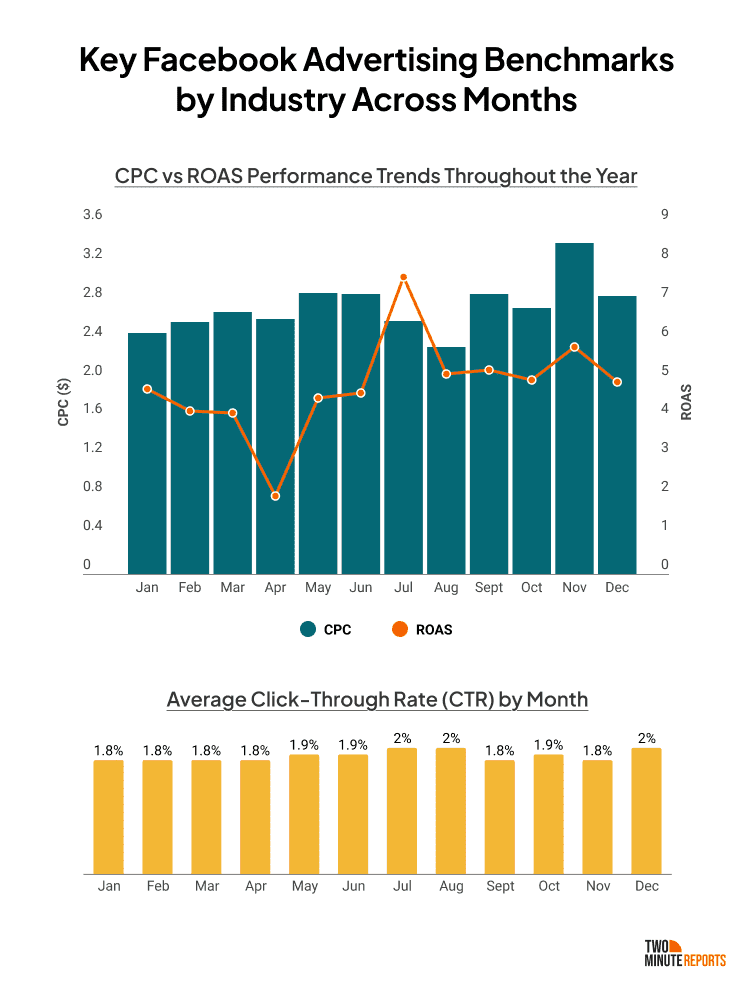
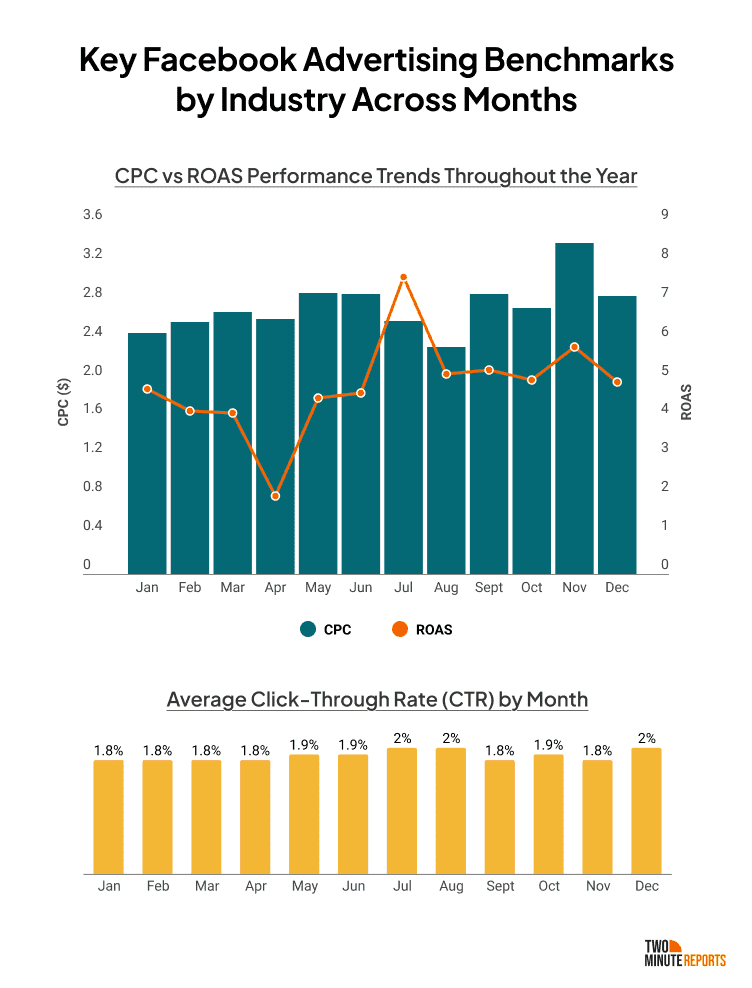
Facebook Ads Median Cost Per Click (CPC)
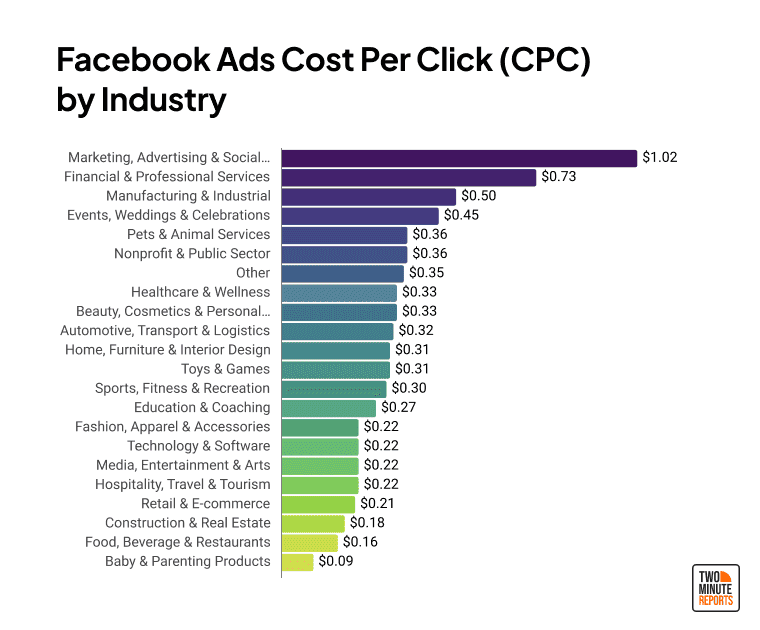
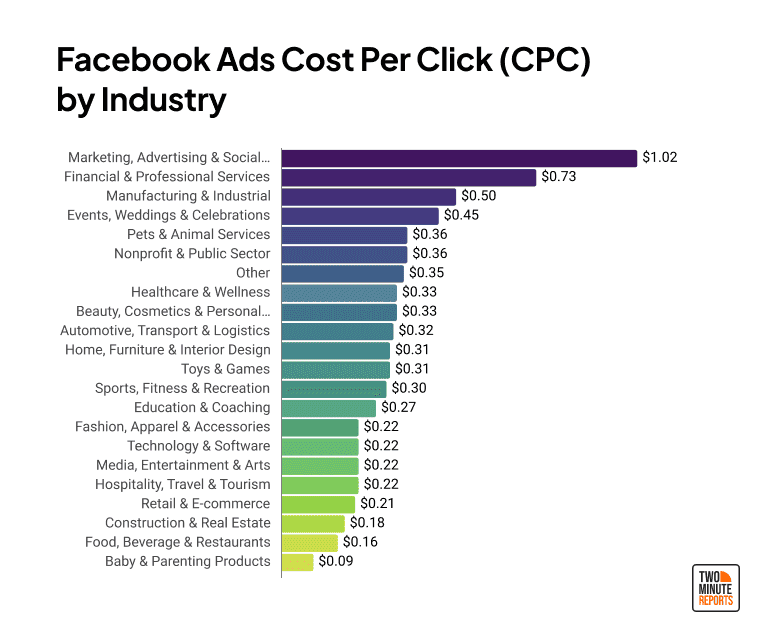
If you’ve noticed your budget stretching a little thinner lately, the pressure point is likely your Cost Per Click (CPC). In 2025, getting a user to actually stop scrolling and click is a premium action.
Much like how high-ticket industries accept a higher Cost Per Action (CPA) because the lifetime value of a client is so significant, the CPC follows a similar logic. For instance, Marketing, Advertising & Social Media see a high average CPC of $1.021.
Our dataset reveals that high-intent services (Nonprofit & Public Sector) currently see the highest costs at $0.357, while high-volume retail (Baby & Parenting Products) remains one of the most affordable entries at just $0.093.
Facebook Ads Median Click-Through Rate (CTR)
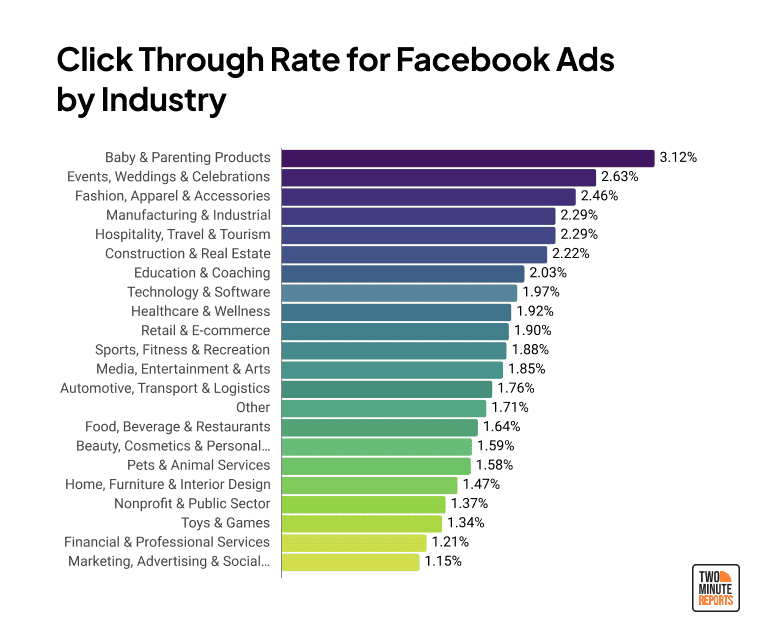
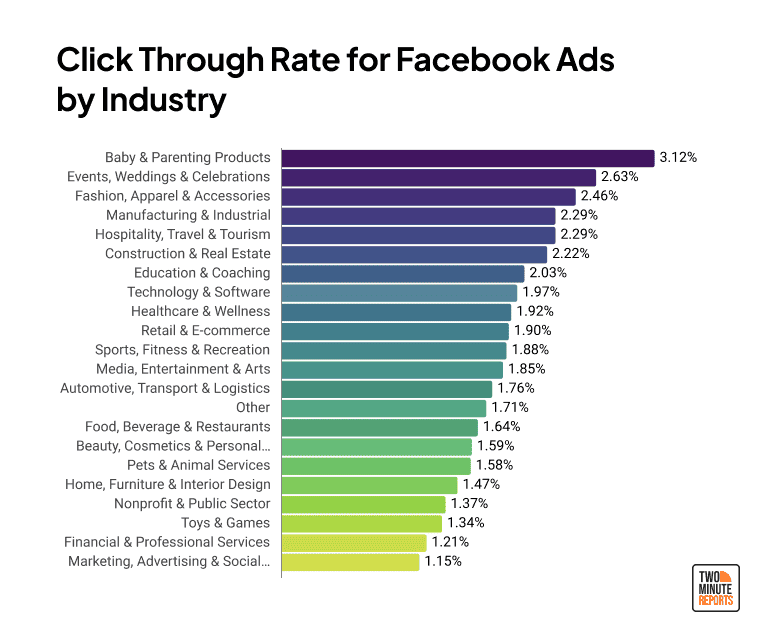
CTR (Click-Through Rate) acts as a direct scorecard for your ad’s creative appeal. A high CTR is a byproduct of visual resonance.
Industries rooted in lifestyle and discovery consistently dominate the attention economy. Baby & Parenting Products currently holds the top spot with a 3.12% CTR, followed closely by Events, Weddings & Celebrations at 2.63%. These sectors benefit from high-quality, aspirational content that stops the scroll by offering immediate visual value.
Conversely, high-friction industries where the user must perform a mental calculation (like assessing a loan or a professional service) naturally see lower engagement. Financial Services and Nonprofits both hover at a 1.3% CTR. In these sectors, the click isn't an impulse; it's a commitment, which explains the tighter engagement rates compared to the retail or travel sectors.
Facebook Ads Website Purchase Conversion Value (ROAS)
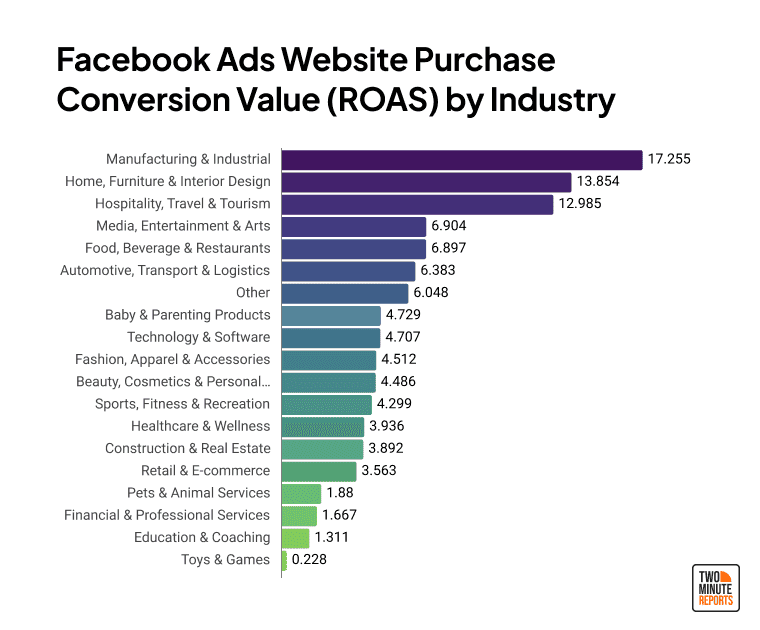
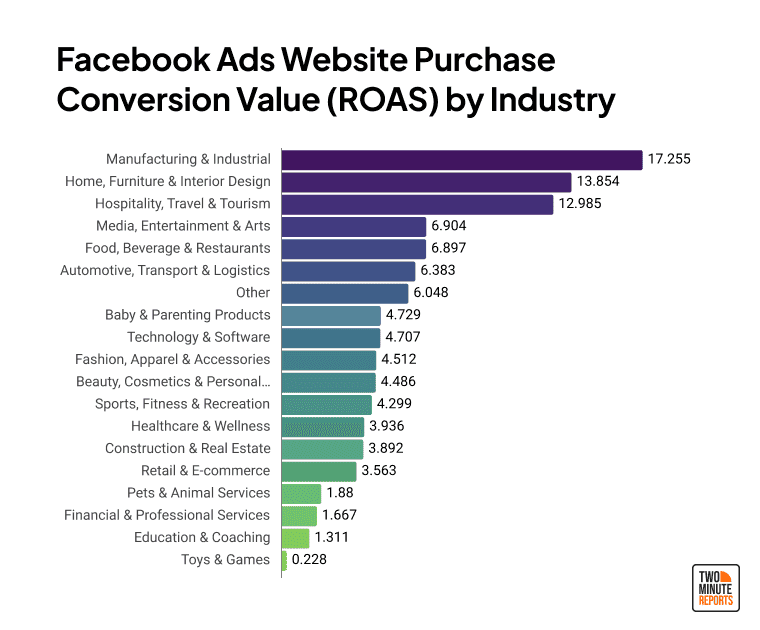
The median dataset highlights Manufacturing & Industrial as the outlier with a staggering 17.26x ROAS. This isn't because industrial ads are better than others, but because a single conversion in this space can be worth hundreds of thousands of dollars.
Similarly, Hospitality, Travel & Tourism boasts a strong 12.9x ROAS. When someone clicks an ad to book a week-long luxury resort stay, the transaction value is significantly higher than a standard retail purchase, allowing for much wider returns on the initial ad spend.
For the majority of B2C advertisers, the benchmarks sit in a more active range. Food, Beverage & Restaurants (6.9x) and Home & Interior Design (13.9x) are crushing it in 2025 by leveraging high visual appeal to drive immediate, mid-to-high value sales.
Facebook Ads Benchmarks by Country and Industry
Global averages only tell part of the story. A $0.94 CPC might be efficient in the US but expensive in Southeast Asia. An 8x ROAS in Retail could be the norm in Germany and an outlier in Brazil.
Use the explorer below to filter benchmarks by your country and industry. If your numbers are running significantly above the benchmark for your market, that's usually a targeting or creative problem, not a budget one.
| Median spend | $61,626 |
| Median clicks | 53,842 |
| Median impressions | 2,104,350 |
| Purchase value | $77,409 |
Showing 447 industry-country combinations across all industries. Some countries may show partial data — metrics not available for a combination are not displayed.
Benchmarks vary significantly across markets, so use these numbers as your baseline, not your target.
How to Make Sense of Benchmark Data for Smarter Decisions?
So, you have the numbers, now what? Benchmarks aren't just a scoreboard; they’re a diagnostic tool. If you’re not meeting the industry standard, it’s rarely a single mistake. It’s usually a signal that one specific part of your machine is out of alignment.
1. Diagnose the Leaky Bucket
Think of your campaign as a funnel. Benchmarks help you find exactly where the holes are:
- High CPC + Low CTR: Your creative isn't resonating, or you're targeting the wrong crowd. The algorithm is charging you more because people aren't engaging.
- High CTR + Low CVR: Your ad is doing its job (getting the click), but your landing page is failing to close the deal. Check your site speed, mobile optimization, or offer clarity.
- Low CPC + Low ROAS: You’re getting cheap traffic, but it’s poor quality. You might be winning the auction but losing the sale.
2. Set Tiered Goals
Don't just aim for the average. In 2025, top-tier advertisers don’t stop at benchmarks – they use them as a baseline for improvement. We recommend a Green-Yellow-Red system for your agency reports:
- Baseline (Red): At or below industry median. Action: Prioritize testing and structural improvements.
- Growth (Yellow): Beating the benchmark by 10-20%. Action: Steady optimization.
- Scale (Green): Top 10% of your niche. Action: Explore incremental budget increases while closely monitoring marginal returns.
3. Focus on Efficiency over Volume
With Lead Gen costs rising significantly (averaging $21.98+), the 2025 winner isn't the one with the most leads; it's the one with the best CPA-to-LTV ratio. Benchmarks tell you what a lead should cost, but your internal data tells you what a lead is worth. If your industry average is $20 but your leads are worth $500, you can afford to be the expensive advertiser.
The Benchmarks are the Floor, Not the Ceiling
Facebook advertising in 2025 is a game of precision, where the right strategic optimizations drive measurable gains. As automation through Advantage+ and AI-driven creative becomes the norm, the gap between average and excellent is widening.
Benchmarks provide the essential context you need to communicate value to clients and make confident pivots. They stop the guessing game and replace it with a data-backed roadmap. But remember: a benchmark is a starting point. Your goal isn't just to blend in with the industry; it's to use these insights to find the market inefficiencies and turn them into a competitive advantage.
Frequently Asked Questions
In 2025, the key benchmarks are a Cost Per Click (CPC) of $0.30, a Click-Through Rate (CTR) of 1.5%, and a Return on Ad Spend (ROAS) of 2.06x.
Benchmarks help you understand how your ads are performing compared to industry standards, allowing you to make informed decisions about your strategy and budget. They serve as a diagnostic tool to identify issues and optimize your campaigns effectively.
An increase in CPC means that your Customer Acquisition Cost (CAC) will rise if your conversion rate remains the same. This can put pressure on your budget, making it essential to monitor benchmarks to adjust your strategy accordingly.
If your CTR is below the industry average, it may indicate that your ad creative isn't resonating with your audience. Consider refreshing your content to make it more engaging and appealing.
Use benchmarks to identify areas for improvement in your campaigns. For example, if you have a high CPC but a low CTR, it suggests your creative may need work, while a high CTR and low conversion rate indicates issues with your landing page.
The 3-second rule emphasizes that if your ad doesn't capture attention within the first three seconds, the algorithm may deprioritize it. This highlights the importance of creating engaging, authentic content to prevent users from scrolling.