

Shopify

The Shopify connector gets your Shopify data into Google Sheets and Google Data Studio. Use it to track your key metrics in a spreadsheet or a Google Data Studio report.
What you can report on
- Orders and revenue
- Product performance
- Inventory, now and at the end of each day, week, month or year
- Customer data
Prerequisites
- A Shopify store
- Store owner access, or staff access with the App development and Manage and install apps and channels permissions. Without both, the connection can't install the Two Minute Reports app.
How to grant the permissions
In your Shopify admin:
- Open Settings › Users and permissions.
- Select the staff member, or select Add staff to create one.
- Scroll to Permissions.
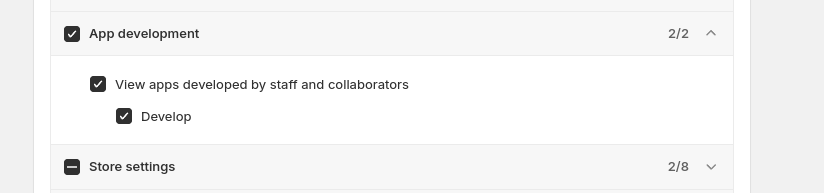
- Turn on App development.
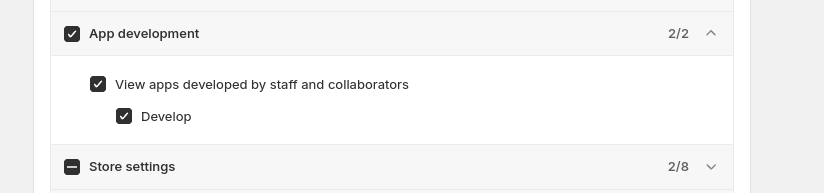
- Turn on Manage and install apps and channels.
How to create a connection
- In the Hub, open Connections & accounts.
- Select Create connection.
- Select Shopify in the connector list.
- Select Next.
- In Name the connection, enter a name.
- In Select app type, select Shopify public app.
- In Store name, enter your store name.
https://thisismyshop.myshopify.com, the store name is thisismyshop.- Select Test and save.
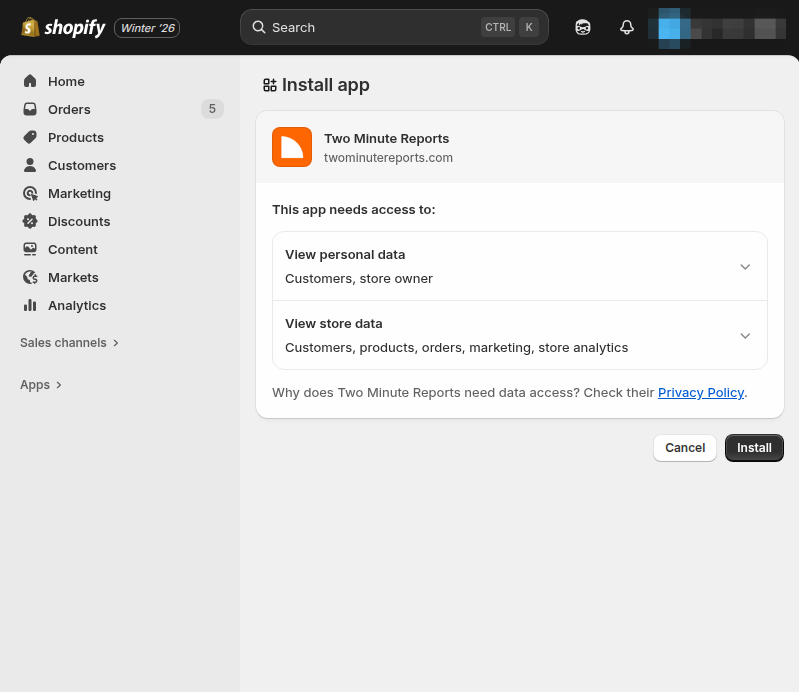
- In the window that opens, authorize and install the Two Minute Reports app. Then close the window.
- Enable the stores you want to report on.
- Select Done.
Connect with a Shopify admin custom app
Shopify admin custom app is the alternative to the public app. Select it in Select app type. Then enter your Access token and Store name instead of authorizing through Shopify.
Shopify Partners custom app and Private app are deprecated. You can't select them.
How to get Shopify data into Google Sheets
To get Shopify data into Google Sheets:
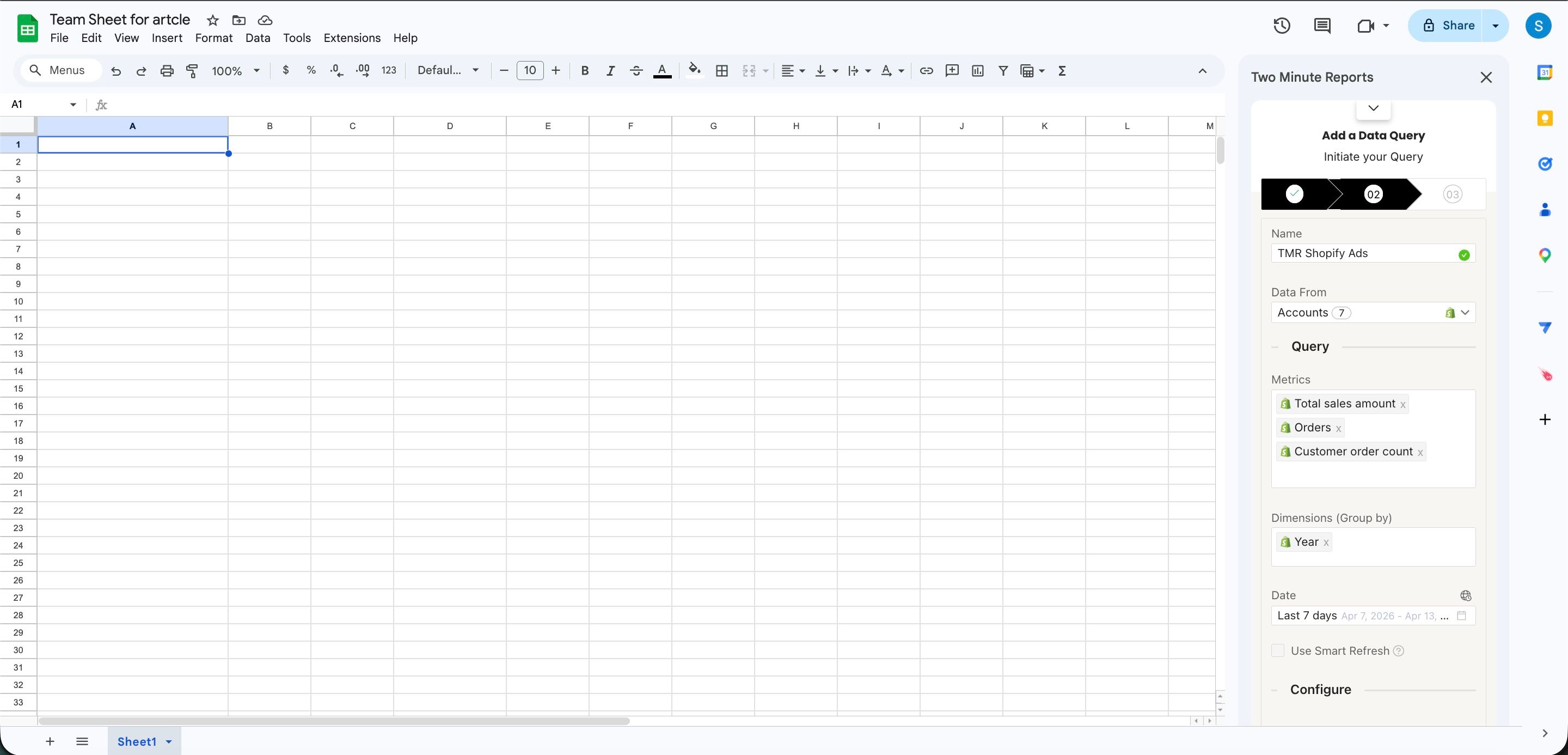
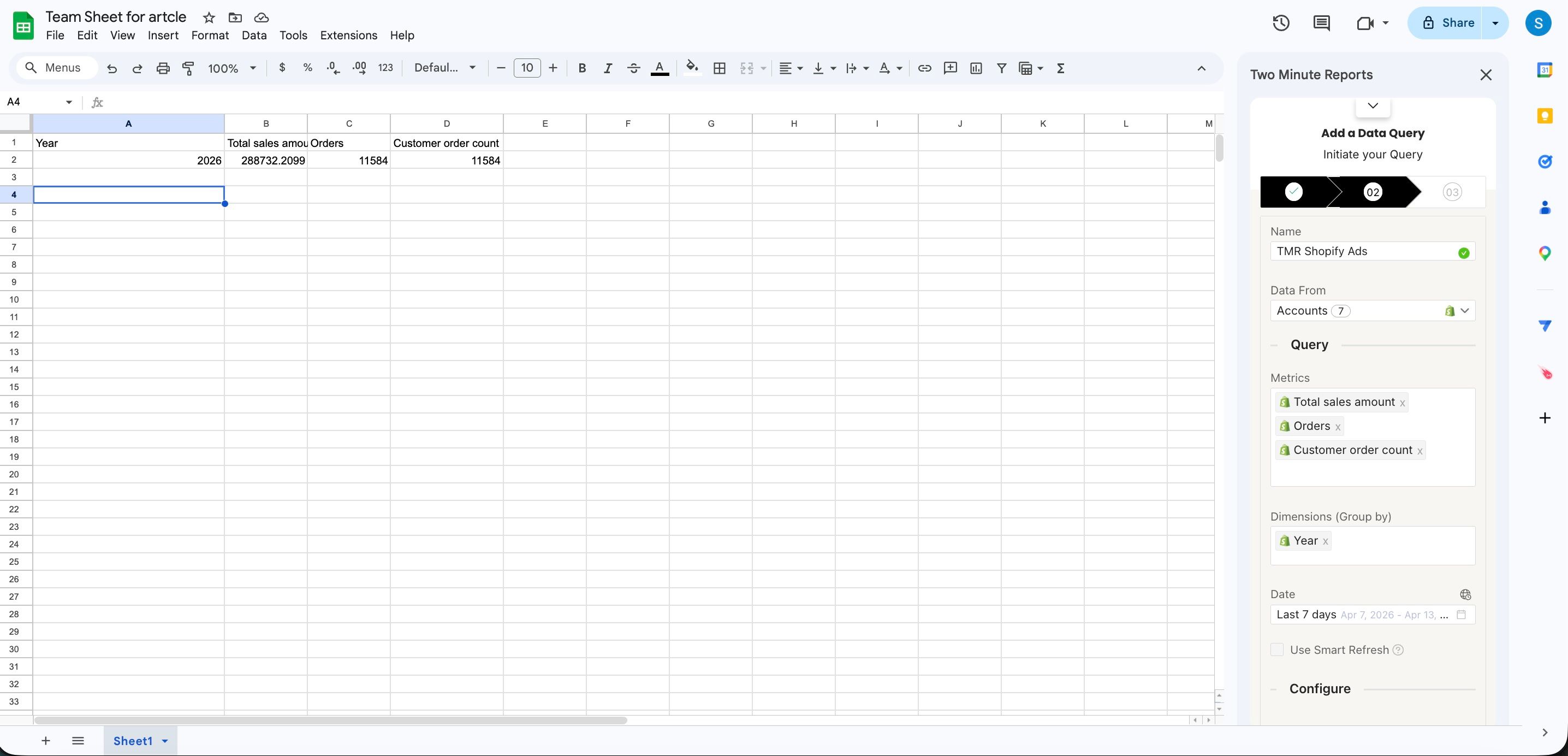
- In the Two Minute Reports sidebar, open Data Queries.
- Select Add.
- Select the accounts you want to report on. You can select more than one.
- Select your metrics and dimensions.
- Select the date range.
- Set sorting and filters if you need them.
- Select Run query. Two Minute Reports adds the data to your sheet.
Report on inventory
The Inventory metric group has two types of metric:
| Metric | What it shows |
|---|---|
| Inventory quantity and Inventory value | The stock in your store now |
| Ending inventory units and Ending inventory value | The stock at the end of the date range, or at the end of each period that you select |
See how your stock changed
Use Ending inventory units or Ending inventory value with a dimension from the Time group:
- Date shows the stock at the end of each day.
- A week, month or year dimension, for example Year month, shows the stock at the end of each period.
Without a Time dimension, these metrics show the stock at the end of the date range.
You can use these metrics with:
- The Product dimensions, for example Product title and Variant SKU, and the store dimensions.
- Inventory location, to show the stock in each location.
- Sales metrics, for example Total sales amount, to show stock and sales in one report.
You cannot use these metrics with:
- Hour. The stock history has one value for each day.
- Dimensions from the Line Item, Order, Customer Details, Customer Geo, Traffic source or Payments groups.
- Inventory quantity or Inventory value, in the same query.
Inventory location works only with Ending inventory units or Ending inventory value. You cannot use it with sales metrics, because Shopify keeps stock for each location, but not sales.
Current stock
Inventory quantity and Inventory value show the stock now. Do not use them with a Time dimension. To see the stock on a date, use Ending inventory units or Ending inventory value.
Sales and payment fields
Shopify keeps the sales and the payments of an order as two different lists. One order can have many sale lines, for example a product, shipping and a tip. It can also have many payments, for example a card payment, a gift card and a refund. The two lists do not align, so a query that has both would multiply the values and show totals that are too high.
Thus, you cannot use fields from these two sets in the same query:
| Sales fields | Payment fields |
|---|---|
| Metrics from the Sales, Order, Product and Customer groups | Metrics from the Payments group |
| Dimensions from the Product and Line Item groups, and Sale kind and Sale item type | Dimensions from the Payments group |
You can use the other dimensions, for example Date, with the sales fields or with the payment fields.
If you select fields from the two sets, the query form shows a message that names the two groups. For example:
Cannot use Metric group 'Sales' along with Dimension group 'Payments'
To see sales and payments, make two queries: one with the sales fields, and one with the payment fields. Use the same dimensions, for example Date, in the two queries.
Troubleshooting
The Shopify store is unavailable
A query, a schedule or a connection shows this message:
The Shopify Store is currently unavailable. Please try again later.
Shopify has the store out of service. For example, the store is frozen because a Shopify bill is not paid, or the store is paused in the Shopify admin. This is not a problem with your connection or your permissions:
- You do not have to reconnect or authenticate the connection again.
- Two Minute Reports does not disable the account.
- Runs fail with this message and get no data until Shopify serves the store again.
To fix it:
- Make the store available again in Shopify. For example, pay the Shopify bill, or open the store again in the Shopify admin.
- Run the query again. If a scheduled refresh did not get data while the store was not available, run the query again for those dates.
If the store is active in Shopify but this message continues, send an email to [email protected] with the store name and the time of a failed run.
The stock history is not available
An Ending inventory query shows this message:
We could not read your stock history because this Shopify connection does not have permission to read reports. Please edit your connection, switch to the Shopify public app method and save. Your historical data will then be backfilled automatically. If you need help, email [email protected].
The connection uses a Shopify admin custom app that does not have permission to read reports. To fix it:
- Edit the connection.
- In Select app type, select Shopify public app, and authorize it.
- Save the connection.
Two Minute Reports then gets the stock history at the next sync. You do not have to do more steps.