

API Bridge: How to Set Your Base URL
The API Bridge connector lets Two Minute Reports pull data from any REST API. The Base URL is the foundation of your connection — every request is built by joining your Base URL with the Suffix URL of the endpoint you want to query.
What should I enter as the Base URL?
Your Base URL should be the root address of the API itself — the part that's shared by the endpoints you'll use, without a specific resource path.
Good examples:
https://api.example.comhttps://api.example.com/v1https://api.example.com/v3/data
Not recommended:
https://example.com/loginhttps://portal.example.com/dashboardhttps://api.example.com/v3/data/records
A login page or dashboard is a web application, not an API. Similarly, a URL that already contains a specific resource should generally be used as the Suffix URL instead.
You can check your Base URL by opening it in a browser. If it displays a login screen, dashboard, or other HTML page intended for users, it is likely not the correct API Base URL. A real API root may return JSON, an API-specific error, or a 404 response instead.
Base URL vs. Suffix URL
When you build a query, you'll specify a Suffix URL — the specific path for the data you want, such as /users or /records.
Two Minute Reports combines the Base URL and Suffix URL to create the request URL:
- Base URL:
https://api.example.com/v3/data - Suffix URL:
/records - Request:
https://api.example.com/v3/data/records
Avoid duplicate paths
A common configuration mistake is including the same path in both the Base URL and Suffix URL. For example:
- Base URL:
https://api.example.com/v3/data/records - Suffix URL:
/v3/data/records
This produces a duplicated URL, and the request will fail:
https://api.example.com/v3/data/records/v3/data/records
If you see a duplicate path error, remove the repeated resource-specific path from the Base URL and keep it in the Suffix URL.
The validation also detects cases where part of the Base URL path is repeated in the Suffix URL. For example, if your Base URL is https://api.example.com/v3/data/records, using /records as the Suffix URL will be flagged because it would create a duplicate path.
However, simply having a similar word in both URLs does not necessarily mean there is a duplicate. For example, https://api.example.com/v1/users with /user/preferences is valid, because the Suffix URL does not repeat the existing users path.
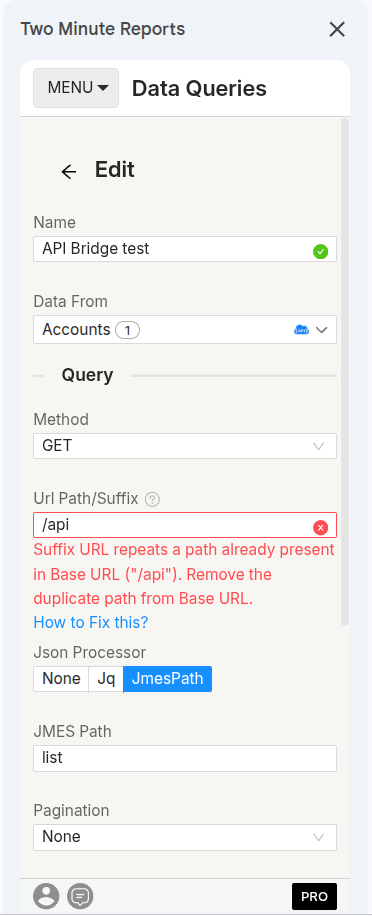
Test your API Bridge connection
When creating or editing an API Bridge connection, you must provide a sample HTTP method and Suffix URL so Two Minute Reports can verify that the connection works. The connection is tested before it is saved.
For example:
- Method:
GET - Suffix URL:
/records
Two Minute Reports sends a real request using your:
- Base URL
- Authentication
- HTTP method
- Suffix URL
- Request body, when applicable
The connection is saved only after the test succeeds. This helps identify configuration problems such as:
- Incorrect Base URL
- Invalid authentication or credentials
- Unreachable API
- Incorrect endpoint path
- Incorrect HTTP method
Checklist before saving your connection
- Base URL points to the API itself, not a login page or web dashboard.
- Base URL does not contain the specific resource path used in your Suffix URL.
- Base URL is copied from your API provider's documentation.
- Base URL includes
https://. - Suffix URL starts with
/, such as/records. - The same path is not repeated in both Base URL and Suffix URL.
- A valid HTTP method is selected.
- A valid Suffix URL is provided.
Still not working?
If the connection test fails, first verify that the Base URL, authentication, HTTP method, and Suffix URL match the API provider's documentation.
If the test succeeds but your report returns empty data or errors, check the following:
- The HTTP method (
GET,POST, etc.) matches what the endpoint expects. - Required query parameters, such as date ranges or pagination parameters, are included in the Suffix URL or request body — not the Base URL.
- The account or API key has permission to access the specific resource in your Suffix URL.
Account Missing Access or Connection Expiry
How to fix account missing access permissions and connection expiry errors in Two Minute Reports queries and schedules.
Google Says "Service unavailable" When You Open the Add-On
Fix Google's "Service unavailable — you tried to access a service that isn't available for your account" screen when you open the Two Minute Reports add-on in Google Sheets.